

微軟的GraphRAG算得上是最早一批成熟的GraphRAG系統,它把索引階段(抽取實體、關係、構建層級社區並生成摘要)和查詢階段的高級能力整合到了一起。這套方案的優勢在於,可以藉助預先計算好的實體、關係、社區摘要來回答那些宏觀的、主題性的問題,這恰恰是傳統RAG系統基於文檔檢索難以做到的。
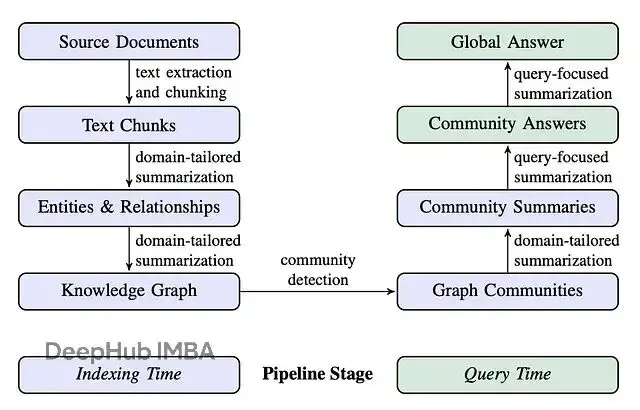
本文的重點是DRIFT搜索:Dynamic Reasoning and Inference with Flexible Traversal,翻譯過來就是"動態推理與靈活遍歷"。這是一種相對較新的檢索策略,兼具全局搜索和局部搜索的特點。
DRIFT的工作流程是這樣的:先通過向量搜索建立一個寬泛的查詢起點,再利用羣信息把原始問題拆解成更細粒度的後續查詢。然後動態地在知識圖譜上游走,抓取實體、關係等局部細節。這種設計在計算效率和答案質量之間找到了一個不錯的平衡點。

上圖為使用 LlamaIndex 工作流和 Neo4j 實現的 DRIFT 搜索,核心流程分一下幾步:
首先是HyDE生成,基於一份樣例社區報告構造假設性答案,用來改善查詢的向量表示。
接着社區搜索登場,通過向量相似度找出最相關的社區報告,給查詢提供宏觀上下文。系統會分析這些結果,輸出一個初步的中間答案,同時生成一批後續查詢用於深挖。
這些後續查詢會在局部搜索階段並行執行,從知識圖譜裏撈出文本塊、實體、關係、以及更多社區報告。這個過程可以迭代多輪,每輪都可能產生新的後續查詢。
最後是答案生成,把過程中積累的所有中間答案彙總起來,融合社區級別的宏觀洞察和局部細節,生成最終響應。整體思路就是先鋪開、再聚焦,層層遞進。
本文用的是《愛麗絲夢遊仙境》,劉易斯·卡羅爾的經典作品,這部小説角色眾多、場景豐富、事件環環相扣,拿來演示GraphRAG的能力再合適不過。
數據導入

整個pipeline遵循標準的GraphRAG流程,分三個階段:
 class MSGraphRAGIngestion(Workflow):
    @step
    async def entity_extraction(self, ev: StartEvent) -> EntitySummarization:
        chunks = splitter.split_text(ev.text)
        await ms_graph.extract_nodes_and_rels(chunks, ev.allowed_entities)
        return EntitySummarization()

    @step
    async def entity_summarization(
        self, ev: EntitySummarization
    ) -> CommunitySummarization:
        await ms_graph.summarize_nodes_and_rels()
        return CommunitySummarization()

    @step
    async def community_summarization(
        self, ev: CommunitySummarization
    ) -> CommunityEmbeddings:
        await ms_graph.summarize_communities()
         return CommunityEmbeddings()
先從文本塊裏抽取實體和關係,再給節點和關係生成摘要,最後構建層級社區並生成社區摘要。
摘要做完之後,要給社區和實體都生成向量嵌入,這樣才能支持相似性檢索。社區嵌入的代碼長這樣:
 @step
    async def community_embeddings(self, ev: CommunityEmbeddings) -> EntityEmbeddings:
        # Fetch all communities from the graph database
        communities = ms_graph.query(
            """
    MATCH (c:__Community__)
    WHERE c.summary IS NOT NULL AND c.rating > $min_community_rating
    RETURN coalesce(c.title, "") + " " + c.summary AS community_description, c.id AS community_id
    """,
            params={"min_community_rating": MIN_COMMUNITY_RATING},
        )
        if communities:
            # Generate vector embeddings from community descriptions
            response = await client.embeddings.create(
                input=[c["community_description"] for c in communities],
                model=TEXT_EMBEDDING_MODEL,
            )
            # Store embeddings in the graph and create vector index
            embeds = [
                {
                    "community_id": community["community_id"],
                    "embedding": embedding.embedding,
                }
                for community, embedding in zip(communities, response.data)
            ]
            ms_graph.query(
                """UNWIND $data as row
            MATCH (c:__Community__ {id: row.community_id})
            CALL db.create.setNodeVectorProperty(c, 'embedding', row.embedding)""",
                params={"data": embeds},
            )
            ms_graph.query(
                "CREATE VECTOR INDEX community IF NOT EXISTS FOR (c:__Community__) ON c.embedding"
            )
         return EntityEmbeddings()
實體嵌入同理,這樣DRIFT搜索需要的向量索引就都建好了。
DRIFT搜索
DRIFT的檢索思路其實很符合簡單:先看大圖,再挖細節。它不會一上來就在文檔或實體層面做精確匹配,而是先去查羣的摘要,因為這些摘要是對知識圖譜主要主題的高層次概括。
拿到相關的高層信息後,DRIFT會智能地派生出後續查詢,去精確檢索特定實體、關係、源文檔。這種兩階段的做法其實很像人類查資料的習慣:先大致瞭解情況再針對性地追問細節。既有全局搜索的覆蓋面,又有局部搜索的精準度,而且不用把所有社區報告或文檔都過一遍,計算開銷控制得不錯。
下面拆解一下各個階段的實現。
羣搜索
DRIFT用了HyDE技術來提升向量檢索的準確率。不是直接拿用户query做embedding,而是先讓模型生成一個假設性的答案,再用這個答案去做相似性搜索。道理很簡單:假設答案在語義上跟真實的摘要更接近。
 @step
async def hyde_generation(self, ev: StartEvent) -> CommunitySearch:
    # Fetch a random community report to use as a template for HyDE generation
    random_community_report = driver.execute_query(
        """
    MATCH (c:__Community__)
    WHERE c.summary IS NOT NULL
    RETURN coalesce(c.title, "") + " " + c.summary AS community_description""",
        result_transformer_=lambda r: r.data(),
    )
    # Generate a hypothetical answer to improve query representation
    hyde = HYDE_PROMPT.format(
        query=ev.query, template=random_community_report[0]["community_description"]
    )
    hyde_response = await client.responses.create(
        model="gpt-5-mini",
        input=[{"role": "user", "content": hyde}],
        reasoning={"effort": "low"},
    )
     return CommunitySearch(query=ev.query, hyde_query=hyde_response.output_text)
拿到HyDE query之後,做embedding,然後通過向量相似度撈出top 5的報告。接着讓LLM基於這些報告生成一個初步答案,同時識別出需要深挖的後續查詢。將初步答案存起來然後進行後續查詢全部並行分發到局部搜索階段。
@step
async def community_search(self, ctx: Context, ev: CommunitySearch) -> LocalSearch:
    # Create embedding from the HyDE-enhanced query
    embedding_response = await client.embeddings.create(
        input=ev.hyde_query, model=TEXT_EMBEDDING_MODEL
    )
    embedding = embedding_response.data[0].embedding

    # Find top 5 most relevant community reports via vector similarity
    community_reports = driver.execute_query(
        """
    CALL db.index.vector.queryNodes('community', 5, $embedding) YIELD node, score
    RETURN 'community-' + node.id AS source_id, node.summary AS community_summary
    """,
        result_transformer_=lambda r: r.data(),
        embedding=embedding,
    )

    # Generate initial answer and identify what additional info is needed
    initial_prompt = DRIFT_PRIMER_PROMPT.format(
        query=ev.query, community_reports=community_reports
    )
    initial_response = await client.responses.create(
        model="gpt-5-mini",
        input=[{"role": "user", "content": initial_prompt}],
        reasoning={"effort": "low"},
    )
    response_json = json_repair.loads(initial_response.output_text)
    print(f"Initial intermediate response: {response_json['intermediate_answer']}")

    # Store the initial answer and prepare for parallel local searches
    async with ctx.store.edit_state() as ctx_state:
        ctx_state["intermediate_answers"] = [
            {
                "intermediate_answer": response_json["intermediate_answer"],
                "score": response_json["score"],
            }
        ]
        ctx_state["local_search_num"] = len(response_json["follow_up_queries"])

    # Dispatch follow-up queries to run in parallel
    for local_query in response_json["follow_up_queries"]:
        ctx.send_event(LocalSearch(query=ev.query, local_query=local_query))
     return None
這就是DRIFT的核心思路,先用HyDE增強的社區搜索鋪開,再用後續查詢往下鑽。
局部搜索
局部搜索階段把後續查詢並行跑起來,深入到具體細節。每個查詢通過實體向量檢索拿到目標上下文,生成中間答案,可能還會產出更多後續查詢。
 @step(num_workers=5)
async def local_search(self, ev: LocalSearch) -> LocalSearchResults:
    print(f"Running local query: {ev.local_query}")

    # Create embedding for the local query
    response = await client.embeddings.create(
        input=ev.local_query, model=TEXT_EMBEDDING_MODEL
    )
    embedding = response.data[0].embedding

    # Retrieve relevant entities and gather their associated context:
    # - Text chunks where entities are mentioned
    # - Community reports the entities belong to
    # - Relationships between the retrieved entities
    # - Entity descriptions
    local_reports = driver.execute_query(
        """
CALL db.index.vector.queryNodes('entity', 5, $embedding) YIELD node, score
WITH collect(node) AS nodes
WITH
collect {
  UNWIND nodes as n
  MATCH (n)<-[:MENTIONS]->(c:__Chunk__)
  WITH c, count(distinct n) as freq
  RETURN {chunkText: c.text, source_id: 'chunk-' + c.id}
  ORDER BY freq DESC
  LIMIT 3
} AS text_mapping,
collect {
  UNWIND nodes as n
  MATCH (n)-[:IN_COMMUNITY*]->(c:__Community__)
  WHERE c.summary IS NOT NULL
  WITH c, c.rating as rank
  RETURN {summary: c.summary, source_id: 'community-' + c.id}
  ORDER BY rank DESC
  LIMIT 3
} AS report_mapping,
collect {
  UNWIND nodes as n
  MATCH (n)-[r:SUMMARIZED_RELATIONSHIP]-(m)
  WHERE m IN nodes
  RETURN {descriptionText: r.summary, source_id: 'relationship-' + n.name + '-' + m.name}
LIMIT 3
} as insideRels,
collect {
  UNWIND nodes as n
  RETURN {descriptionText: n.summary, source_id: 'node-' + n.name}
} as entities
RETURN {Chunks: text_mapping, Reports: report_mapping,
   Relationships: insideRels,
   Entities: entities} AS output
""",
        result_transformer_=lambda r: r.data(),
        embedding=embedding,
    )

    # Generate answer based on the retrieved context
    local_prompt = DRIFT_LOCAL_SYSTEM_PROMPT.format(
        response_type=DEFAULT_RESPONSE_TYPE,
        context_data=local_reports,
        global_query=ev.query,
    )
    local_response = await client.responses.create(
        model="gpt-5-mini",
        input=[{"role": "user", "content": local_prompt}],
        reasoning={"effort": "low"},
    )
    response_json = json_repair.loads(local_response.output_text)

    # Limit follow-up queries to prevent exponential growth
    response_json["follow_up_queries"] = response_json["follow_up_queries"][:LOCAL_TOP_K]

     return LocalSearchResults(results=response_json, query=ev.query)
下一步負責編排迭代深化的過程。用
collect_events等所有並行搜索跑完,然後判斷要不要繼續往下挖。如果當前深度還沒到上限(這裏設的max depth=2),就把所有結果裏的後續查詢提取出來,存好中間答案分發下一輪並行搜索。
 @step
async def local_search_results(
    self, ctx: Context, ev: LocalSearchResults
) -> LocalSearch | FinalAnswer:
    local_search_num = await ctx.store.get("local_search_num")

    # Wait for all parallel searches to complete
    results = ctx.collect_events(ev, [LocalSearchResults] * local_search_num)
    if results is None:
        return None

    intermediate_results = [
        {
            "intermediate_answer": event.results["response"],
            "score": event.results["score"],
        }
        for event in results
    ]
    current_depth = await ctx.store.get("local_search_depth", default=1)
    query = [ev.query for ev in results][0]

    # Continue drilling down if we haven't reached max depth
    if current_depth < MAX_LOCAL_SEARCH_DEPTH:
        await ctx.store.set("local_search_depth", current_depth + 1)
        follow_up_queries = [
            query
            for event in results
            for query in event.results["follow_up_queries"]
        ]

        # Store intermediate answers and dispatch next round of searches
        async with ctx.store.edit_state() as ctx_state:
            ctx_state["intermediate_answers"].extend(intermediate_results)
            ctx_state["local_search_num"] = len(follow_up_queries)

        for local_query in follow_up_queries:
            ctx.send_event(LocalSearch(query=query, local_query=local_query))
        return None
    else:
         return FinalAnswer(query=query)
這樣就形成了一個迭代細化的循環,每一層都在前一層的基礎上繼續深挖。達到最大深度後,觸發最終答案生成。
最終答案
最後一步把整個DRIFT搜索過程中積攢的所有中間答案彙總成一個完整的響應:這裏包括社區搜索的初步答案,以及局部搜索各輪迭代產出的答案。
 @step
async def final_answer_generation(self, ctx: Context, ev: FinalAnswer) -> StopEvent:
    # Retrieve all intermediate answers collected throughout the search process
    intermediate_answers = await ctx.store.get("intermediate_answers")

    # Synthesize all findings into a comprehensive final response
    answer_prompt = DRIFT_REDUCE_PROMPT.format(
        response_type=DEFAULT_RESPONSE_TYPE,
        context_data=intermediate_answers,
        global_query=ev.query,
    )
    answer_response = await client.responses.create(
        model="gpt-5-mini",
        input=[
            {"role": "developer", "content": answer_prompt},
            {"role": "user", "content": ev.query},
        ],
        reasoning={"effort": "low"},
    )

     return StopEvent(result=answer_response.output_text)
總結
DRIFT搜索提供了一個挺有意思的思路,在全局搜索的廣度和局部搜索的精度之間找到了平衡。從社區級上下文切入,通過迭代的後續查詢逐層下探,既避免了遍歷所有社區報告的計算負擔,又保證了覆蓋面。
這裏還有改進空間,比如目前的實現對所有中間答案一視同仁,如果能根據置信度分數做個篩選,最終答案的質量應該會更好,噪聲也能降下來。後續查詢也可以先按相關性或信息增益排個序,優先追蹤最有價值的線索。
另一個值得嘗試的方向是加一個查詢精煉步驟,用LLM分析所有生成的後續查詢,把相似的歸併起來避免重複搜索,過濾掉那些大概率沒什麼收穫的查詢。這樣能大幅減少局部搜索的次數,同時不影響答案質量。
完整代碼
https://avoid.overfit.cn/post/5eaca452dcc7422d8c2308586e7cfe56
有興趣的可以自己跑跑看,或者在這個基礎上做些改進。
作者:Tomaz Bratanic
