
一、“後退鍵”不會終止程序;二、應用生命週期;三、OnLaunched;四、OnSuspending;五、OnResuming;六、注意
一、“後退鍵”不會終止應用
關於 Windows Phone 8.1 的應用生命週期,第一個要知道的關鍵就是:“後退鍵”不會終止應用!
在 8.0 時代,不斷的按下“後退鍵”就可以完全的關閉並且終止應用,但在 8.1 中,這樣的行為只會讓應用處在 Suspended(掛起)狀態,可以通過長按“後退鍵”進入多任務界面查看。
那如果還想像 8.0 一樣終止應用呢?(雖然不推薦也沒有必要)可以在多任務界面點擊應用右上角的“叉叉”或者向下滑。
二、應用生命週期
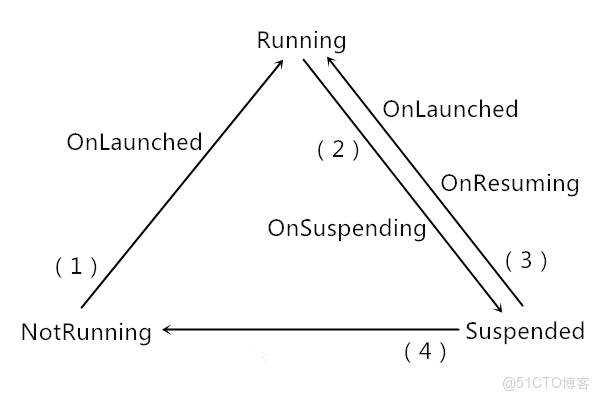
應用的三個狀態分別是:
A:NotRunning
也就是還沒開啓過應用,在多任務界面沒有該應用時。
B:Running
在屏幕上顯示的應用就是 Running 狀態,同時只會有 1 個應用處於 Running 狀態。
C:Suspended
不在屏幕上顯示並能在多任務界面查看的應用則處於 Suspended(掛起)狀態。
三種狀態間切換的操作:
(1)NotRunning -> Running
要從 NotRunning 切換到 Running 狀態,其實也就是開啓應用,可通過點擊應用磁貼、應用間協議啓動、Cortana等方式。
在狀態的切換過程中會觸發 OnLaunched 事件。
(2)Running -> Suspended
當應用不再佔據屏幕時則從 Running 切換到 Suspended 狀態,可以是“Win”鍵、“返回鍵”,有電話打來時也會掛起。
在狀態的切換過程中會觸發 OnSuspending 事件。
(3)Suspended -> Running
如果在應用掛起狀態時沒有因為某些原因(比如內存不足)導致應用終止的話,點擊磁貼或者多任務切換都會讓應用從 Suspender 返回到 Running 狀態。
在狀態的切換過程中會依次觸發 OnResuming 和 OnLaunched 事件。
(4)Suspended -> NotRunning
如果在應用掛起狀態時因為某些原因(比如內存不足)導致應用終止的話,則會從 Suspended 變成 NotRunning 狀態。
在這過程不會觸發任何事件。
三、OnSuspending
因為應用在掛起狀態時,並不能預測應用是否會因為某些原因(比如內存不足)而終止,而在這終止過程中也沒有事件讓開發者處理應用數據,所以只能在應用將要掛起時準備。因此 OnSuspending 事件變得十分重要。
若要使用 OnSuspending 方法則先要在構造函數中添加對其的引用:
public App()
{
  this.InitializeComponent();
  this.Suspending += OnSuspending;
}
而在 OnSuspending 方法中可以根據需要保存頁面數據,比如輸入框內的文本、頁面導航歷史等,可以通過保存在應用獨立存儲中或利用 NavigationHelper 和 SuspensionManager 類等:
async void OnSuspending(object sender, SuspendingEventArgs e)
{
    SuspendingDeferral deferral = e.SuspendingOperation.GetDeferral();

    await this.SaveStateToLocalFile(Data.Value);

await SuspensionManager.SaveAsync();

    deferral.Complete();
}
如果只想保存某個頁面的信息則可以在 SaveState 中保存:
private void NavigationHelper_SaveState(object sender, SaveStateEventArgs e)
{
     e.PageState["isEditing"] = true;
     e.PageState["currentText"] = this.viewModel.DataItem.Title;
}
NavigationHelper 和 SuspensionManager 類是添加基本頁時 Visual Studio 自動添加的:
public class NavigationHelper : DependencyObject
{
    private Page Page { get; set; }
    private Frame Frame { get { return this.Page.Frame; } }

    public NavigationHelper(Page page)
    {
        this.Page = page;

        this.Page.Loaded += (sender, e) =>
        {
WINDOWS_PHONE_APP
            Windows.Phone.UI.Input.HardwareButtons.BackPressed += HardwareButtons_BackPressed;
e

if
        };

        this.Page.Unloaded += (sender, e) =>
        {
WINDOWS_PHONE_APP
            Windows.Phone.UI.Input.HardwareButtons.BackPressed -= HardwareButtons_BackPressed;
e

if
        };
    }

    #region Navigation support

        RelayCommand _goBackCommand;
        RelayCommand _goForwardCommand;

        public RelayCommand GoBackCommand
        {
            get
            {
                if (_goBackCommand == null)
                {
                    _goBackCommand = new RelayCommand(
                        () => this.GoBack(),
                        () => this.CanGoBack());
                }
                return _goBackCommand;
            }
            set
            {
                _goBackCommand = value;
            }
        }

        public RelayCommand GoForwardCommand
        {
            get
            {
                if (_goForwardCommand == null)
                {
                    _goForwardCommand = new RelayCommand(
                        () => this.GoForward(),
                        () => this.CanGoForward());
                }
                return _goForwardCommand;
            }
        }

        public virtual bool CanGoBack()
        {
            return this.Frame != null && this.Frame.CanGoBack;
        }

        public virtual bool CanGoForward()
        {
            return this.Frame != null && this.Frame.CanGoForward;
        }

        public virtual void GoBack()
        {
            if (this.Frame != null && this.Frame.CanGoBack) this.Frame.GoBack();
        }

        public virtual void GoForward()
        {
            if (this.Frame != null && this.Frame.CanGoForward) this.Frame.GoForward();
        }

#if WINDOWS_PHONE_APP
        private void HardwareButtons_BackPressed(object sender, Windows.Phone.UI.Input.BackPressedEventArgs e)
        {
            if (this.GoBackCommand.CanExecute(null))
            {
                e.Handled = true;
                this.GoBackCommand.Execute(null);
            }
        }
#else
        private void CoreDispatcher_AcceleratorKeyActivated(CoreDispatcher sender,
            AcceleratorKeyEventArgs e)
        {
            var virtualKey = e.VirtualKey;

            if ((e.EventType == CoreAcceleratorKeyEventType.SystemKeyDown ||
                e.EventType == CoreAcceleratorKeyEventType.KeyDown) &&
                (virtualKey == VirtualKey.Left || virtualKey == VirtualKey.Right ||
                (int)virtualKey == 166 || (int)virtualKey == 167))
            {
                var coreWindow = Window.Current.CoreWindow;
                var downState = CoreVirtualKeyStates.Down;
                bool menuKey = (coreWindow.GetKeyState(VirtualKey.Menu) & downState) == downState;
                bool controlKey = (coreWindow.GetKeyState(VirtualKey.Control) & downState) == downState;
                bool shiftKey = (coreWindow.GetKeyState(VirtualKey.Shift) & downState) == downState;
                bool noModifiers = !menuKey && !controlKey && !shiftKey;
                bool onlyAlt = menuKey && !controlKey && !shiftKey;

                if (((int)virtualKey == 166 && noModifiers) ||
                    (virtualKey == VirtualKey.Left && onlyAlt))
                {
                    e.Handled = true;
                    this.GoBackCommand.Execute(null);
                }
                else if (((int)virtualKey == 167 && noModifiers) ||
                    (virtualKey == VirtualKey.Right && onlyAlt))
                {
                    e.Handled = true;
                    this.GoForwardCommand.Execute(null);
                }
            }
        }

        private void CoreWindow_PointerPressed(CoreWindow sender,
            PointerEventArgs e)
        {
            var properties = e.CurrentPoint.Properties;

            if (properties.IsLeftButtonPressed || properties.IsRightButtonPressed ||
                properties.IsMiddleButtonPressed) return;

            bool backPressed = properties.IsXButton1Pressed;
            bool forwardPressed = properties.IsXButton2Pressed;
            if (backPressed ^ forwardPressed)
            {
                e.Handled = true;
                if (backPressed) this.GoBackCommand.Execute(null);
                if (forwardPressed) this.GoForwardCommand.Execute(null);
            }
        }
#endif

        #endregion

    #region Process lifetime management

        private String _pageKey;
        public event LoadStateEventHandler LoadState;
        public event SaveStateEventHandler SaveState;

        public void OnNavigatedTo(NavigationEventArgs e)
        {
            var frameState = SuspensionManager.SessionStateForFrame(this.Frame);
            this._pageKey = "Page-" + this.Frame.BackStackDepth;

            if (e.NavigationMode == NavigationMode.New)
            {
                var nextPageKey = this._pageKey;
                int nextPageIndex = this.Frame.BackStackDepth;
                while (frameState.Remove(nextPageKey))
                {
                    nextPageIndex++;
                    nextPageKey = "Page-" + nextPageIndex;
                }

                if (this.LoadState != null)
                {
                    this.LoadState(this, new LoadStateEventArgs(e.Parameter, null));
                }
            }
            else
            {
                if (this.LoadState != null)
                {
                    this.LoadState(this, new LoadStateEventArgs(e.Parameter, (Dictionary<String, Object>)frameState[this._pageKey]));
                }
            }
        }

        public void OnNavigatedFrom(NavigationEventArgs e)
        {
            var frameState = SuspensionManager.SessionStateForFrame(this.Frame);
            var pageState = new Dictionary<String, Object>();
            if (this.SaveState != null)
            {
                this.SaveState(this, new SaveStateEventArgs(pageState));
            }
            frameState[_pageKey] = pageState;
        }

        #endregion
}


public delegate void LoadStateEventHandler(object sender, LoadStateEventArgs e);
public delegate void SaveStateEventHandler(object sender, SaveStateEventArgs e);

public class LoadStateEventArgs : EventArgs
{
    public Object NavigationParameter { get; private set; }
    public Dictionary<string, Object> PageState { get; private set; }

    public LoadStateEventArgs(Object navigationParameter, Dictionary<string, Object> pageState)
        : base()
    {
        this.NavigationParameter = navigationParameter;
        this.PageState = pageState;
    }
}

public class SaveStateEventArgs : EventArgs
{
    public Dictionary<string, Object> PageState { get; private set; }
    public SaveStateEventArgs(Dictionary<string, Object> pageState)
        : base()
    {
        this.PageState = pageState;
    }
}
NavigationHelper
internal sealed class SuspensionManager
    {
        private static Dictionary<string, object> _sessionState = new Dictionary<string, object>();
        private static List<Type> _knownTypes = new List<Type>();
        private const string sessionStateFilename = "_sessionState.xml";

        public static Dictionary<string, object> SessionState
        {
            get { return _sessionState; }
        }

        public static List<Type> KnownTypes
        {
            get { return _knownTypes; }
        }

        public static async Task SaveAsync()
        {
            try
            {
                foreach (var weakFrameReference in _registeredFrames)
                {
                    Frame frame;
                    if (weakFrameReference.TryGetTarget(out frame))
                    {
                        SaveFrameNavigationState(frame);
                    }
                }

                MemoryStream sessionData = new MemoryStream();
                DataContractSerializer serializer = new DataContractSerializer(typeof(Dictionary<string, object>), _knownTypes);
                serializer.WriteObject(sessionData, _sessionState);

                StorageFile file = await ApplicationData.Current.LocalFolder.CreateFileAsync(sessionStateFilename, CreationCollisionOption.ReplaceExisting);
                using (Stream fileStream = await file.OpenStreamForWriteAsync())
                {
                    sessionData.Seek(0, SeekOrigin.Begin);
                    await sessionData.CopyToAsync(fileStream);
                }
            }
            catch (Exception e)
            {
                throw new SuspensionManagerException(e);
            }
        }

        public static async Task RestoreAsync(String sessionBaseKey = null)
        {
            _sessionState = new Dictionary<String, Object>();

            try
            {
                StorageFile file = await ApplicationData.Current.LocalFolder.GetFileAsync(sessionStateFilename);
                using (IInputStream inStream = await file.OpenSequentialReadAsync())
                {
                    DataContractSerializer serializer = new DataContractSerializer(typeof(Dictionary<string, object>), _knownTypes);
                    _sessionState = (Dictionary<string, object>)serializer.ReadObject(inStream.AsStreamForRead());
                }

                foreach (var weakFrameReference in _registeredFrames)
                {
                    Frame frame;
                    if (weakFrameReference.TryGetTarget(out frame) && (string)frame.GetValue(FrameSessionBaseKeyProperty) == sessionBaseKey)
                    {
                        frame.ClearValue(FrameSessionStateProperty);
                        RestoreFrameNavigationState(frame);
                    }
                }
            }
            catch (Exception e)
            {
                throw new SuspensionManagerException(e);
            }
        }

        private static DependencyProperty FrameSessionStateKeyProperty =
            DependencyProperty.RegisterAttached("_FrameSessionStateKey", typeof(String), typeof(SuspensionManager), null);
        private static DependencyProperty FrameSessionBaseKeyProperty =
            DependencyProperty.RegisterAttached("_FrameSessionBaseKeyParams", typeof(String), typeof(SuspensionManager), null);
        private static DependencyProperty FrameSessionStateProperty =
            DependencyProperty.RegisterAttached("_FrameSessionState", typeof(Dictionary<String, Object>), typeof(SuspensionManager), null);
        private static List<WeakReference<Frame>> _registeredFrames = new List<WeakReference<Frame>>();

        public static void RegisterFrame(Frame frame, String sessionStateKey, String sessionBaseKey = null)
        {
            if (frame.GetValue(FrameSessionStateKeyProperty) != null)
            {
                throw new InvalidOperationException("Frames can only be registered to one session state key");
            }

            if (frame.GetValue(FrameSessionStateProperty) != null)
            {
                throw new InvalidOperationException("Frames must be either be registered before accessing frame session state, or not registered at all");
            }

            if (!string.IsNullOrEmpty(sessionBaseKey))
            {
                frame.SetValue(FrameSessionBaseKeyProperty, sessionBaseKey);
                sessionStateKey = sessionBaseKey + "_" + sessionStateKey;
            }

            frame.SetValue(FrameSessionStateKeyProperty, sessionStateKey);
            _registeredFrames.Add(new WeakReference<Frame>(frame));

            RestoreFrameNavigationState(frame);
        }

        public static void UnregisterFrame(Frame frame)
        {
            SessionState.Remove((String)frame.GetValue(FrameSessionStateKeyProperty));
            _registeredFrames.RemoveAll((weakFrameReference) =>
            {
                Frame testFrame;
                return !weakFrameReference.TryGetTarget(out testFrame) || testFrame == frame;
            });
        }

        public static Dictionary<String, Object> SessionStateForFrame(Frame frame)
        {
            var frameState = (Dictionary<String, Object>)frame.GetValue(FrameSessionStateProperty);

            if (frameState == null)
            {
                var frameSessionKey = (String)frame.GetValue(FrameSessionStateKeyProperty);
                if (frameSessionKey != null)
                {
                    if (!_sessionState.ContainsKey(frameSessionKey))
                    {
                        _sessionState[frameSessionKey] = new Dictionary<String, Object>();
                    }
                    frameState = (Dictionary<String, Object>)_sessionState[frameSessionKey];
                }
                else
                {
                    frameState = new Dictionary<String, Object>();
                }
                frame.SetValue(FrameSessionStateProperty, frameState);
            }
            return frameState;
        }

        private static void RestoreFrameNavigationState(Frame frame)
        {
            var frameState = SessionStateForFrame(frame);
            if (frameState.ContainsKey("Navigation"))
            {
                frame.SetNavigationState((String)frameState["Navigation"]);
            }
        }

        private static void SaveFrameNavigationState(Frame frame)
        {
            var frameState = SessionStateForFrame(frame);
            frameState["Navigation"] = frame.GetNavigationState();
        }
    }
public class SuspensionManagerException : Exception
    {
        public SuspensionManagerException()
        {
        }

        public SuspensionManagerException(Exception e)
            : base("SuspensionManager failed", e)
        {

        }
    }
SuspensionManager
四、OnResuming
既然在 OnSuspending 和 SaveState 方法中保存了必要數據,就可以在 OnResuming 和 LoadState 方法中獲取之前保存的數據:
void OnResuming(object sender, object e)
{
    Data.Value += this.CalculateOffsetTimeInDecimalSeconds(this.suspensionTime);
}
private void NavigationHelper_LoadState(object sender, LoadStateEventArgs e)
{
if ((e.PageState != null) && e.PageState.ContainsKey("isEditing"))
{
this.viewModel.SetEditMode();
this.viewModel.DataItem.Title = e.PageState["currentText"] as string;
}
}
五、OnLaunched
首先,在 OnLaunched 方法中可以通過 e.PreviousExecutionState 瞭解到應用之前的狀態。
狀態包括:
(1)CloseByUser:被用户主動在多任務界面中關閉
(2)NotRunning:沒有啓動過
(3)Running:啓動中
(4)Terminated:掛起狀態時因內存不足被系統終止
(5)Suspended:掛起狀態
因此,可以通過對此的判斷,根據不同情況處理應用:
protected async override void OnLaunched(LaunchActivatedEventArgs e)
{
  Frame rootFrame = Window.Current.Content as Frame;

  if (rootFrame == null)
  {
    rootFrame = new Frame();

    SuspensionManager.RegisterFrame(rootFrame, "AppFrame");

    rootFrame.Language = Windows.Globalization.ApplicationLanguages.Languages[0];

    if (e.PreviousExecutionState == ApplicationExecutionState.Terminated)
    {
      try
      {
        await SuspensionManager.RestoreAsync();
      }
      catch (SuspensionManagerException)
      {
      }
    }

    Window.Current.Content = rootFrame;
  }

  if (rootFrame.Content == null)
  {
    rootFrame.Navigate(typeof(MainPage), e.Arguments);
  }

  Window.Current.Activate();
}
六、注意
以上的方法儘量使用異步操作,不要進行大量的複雜操作。
