
基於 Microsoft Agent Framework 實現第三方聊天曆史存儲
理解 Microsoft Agent Framework
Microsoft Agent Framework 是一個用於構建對話式 AI 應用的框架,支持自然語言處理和上下文管理。其核心組件包括 Bot Framework SDK 和 Azure Bot Service,但默認聊天曆史通常存儲在 Azure 服務中。
具體實現可參考NetCoreKevin的kevin.AI.AgentFramework和KevinAIChatMessageStore服務模塊
基於NET構建的現代化AI智能體Saas企業級架構:
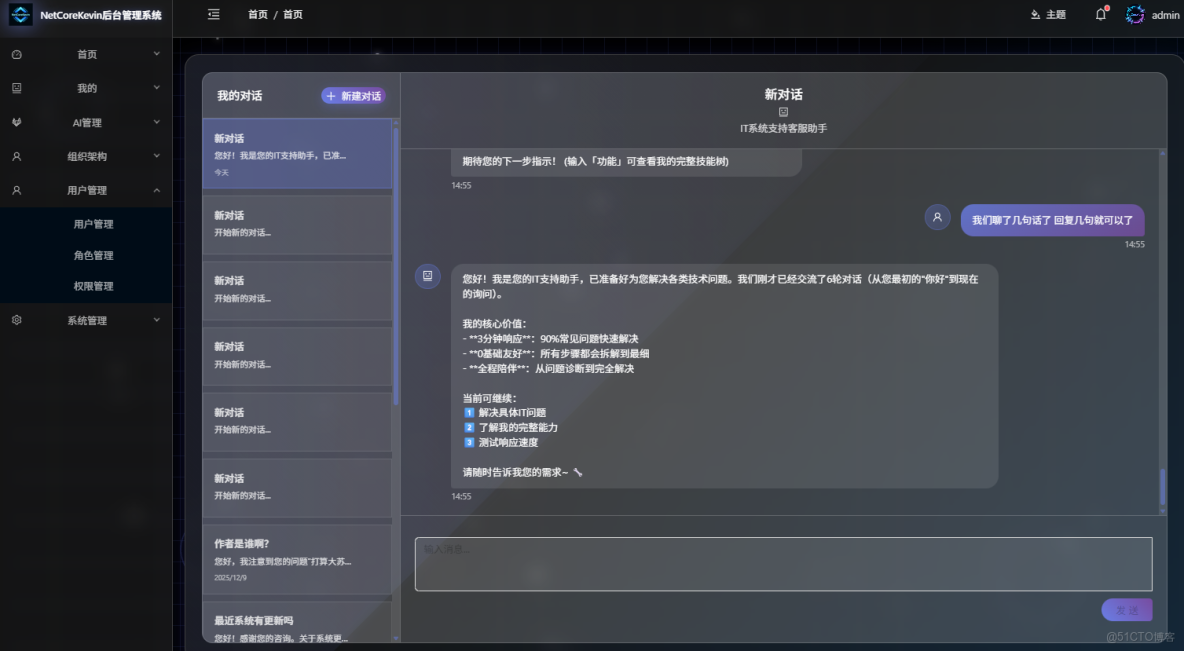
項目地址:github:https://github.com/junkai-li/NetCoreKevin Gitee: https://gitee.com/netkevin-li/NetCoreKevin
配置自定義存儲提供程序
- **實現
ChatMessageStore** 創建自定義存儲類繼承Microsoft.Bot.Builder.IStorage,需實現以下方法:
public sealed class KevinChatMessageStore : ChatMessageStore
 {
     private IKevinAIChatMessageStore _chatMessageStore;
     public string ThreadDbKey { get; private set; }
     public KevinChatMessageStore(
         IKevinAIChatMessageStore vectorStore,
         JsonElement serializedStoreState,
         string AIChatsId,
         JsonSerializerOptions? jsonSerializerOptions = null)
     {
         this._chatMessageStore = vectorStore ?? throw new ArgumentNullException(nameof(vectorStore));
         this.ThreadDbKey = AIChatsId;
     }


     public override async Task AddMessagesAsync(
         IEnumerable<ChatMessage> messages,
         CancellationToken cancellationToken)
     {
         await _chatMessageStore.AddMessagesAsync(messages.Select(x => new ChatHistoryItemDto()
         {
             Key = this.ThreadDbKey + x.MessageId,
             Timestamp = DateTimeOffset.UtcNow,
             ThreadId = this.ThreadDbKey,
             MessageId = x.MessageId,
             Role = x.Role.Value,
             SerializedMessage = JsonSerializer.Serialize(x),
             MessageText = x.Text
         }).ToList(), cancellationToken);
         // 設置前景色為紅色
         // 保存原始顏色,以便之後恢復
         ConsoleColor originalColor = Console.ForegroundColor;
         Console.ForegroundColor = ConsoleColor.Red;
         Console.WriteLine("聊天消息記錄:", Color.Red);
         messages.Select(x => x.Text).ToList().ForEach(t => Console.WriteLine(t));
         // 設置前景色為紅色
         Console.ForegroundColor = ConsoleColor.Red;
         Console.WriteLine("聊天消息記錄添加完成", Color.Red);
         // 恢復原始顏色
         Console.ForegroundColor = originalColor;
     }

     public override async Task<IEnumerable<ChatMessage>> GetMessagesAsync(
         CancellationToken cancellationToken)
     {
         var data = await _chatMessageStore.GetMessagesAsync(this.ThreadDbKey, cancellationToken);
         var messages = data.ConvertAll(x => JsonSerializer.Deserialize<ChatMessage>(x.SerializedMessage!)!);
         messages.Reverse();
         ConsoleColor originalColor = Console.ForegroundColor;
         Console.ForegroundColor = ConsoleColor.Red;
         Console.WriteLine("所有聊天消息記錄開始:", Color.Red);
         messages.Select(x => x.Text).ToList().ForEach(t => Console.WriteLine(t));
         Console.WriteLine("所有聊天消息記錄結束:", Color.Red);
         // 恢復原始顏色
         Console.ForegroundColor = originalColor;
         return messages;
     }

     public override JsonElement Serialize(JsonSerializerOptions? jsonSerializerOptions = null) =>
         // We have to serialize the thread id, so that on deserialization you can retrieve the messages using the same thread id.
         JsonSerializer.SerializeToElement(this.ThreadDbKey);
}- 實現IKevinAIChatMessageStore
Task AddMessagesAsync(List<ChatHistoryItemDto> chatHistoryItems, CancellationToken cancellationToken);

Task<List<ChatHistoryItemDto>> GetMessagesAsync(string threadId, CancellationToken cancellationToken);- 實現注入到AI中間件中 1.定義AI服務:
/// <summary>
 /// AI服務
 /// </summary>
 public class AIAgentService : IAIAgentService
 {
     public AIAgentService()
     {
     }
     public async Task<AIAgent> CreateOpenAIAgent(string name, string prompt, string description, string url, string model, string keySecret,
         IList<AITool>? tools = null, ChatResponseFormat? chatResponseFormat = null, Func<IChatClient, IChatClient>? clientFactory = null, ILoggerFactory? loggerFactory = null, IServiceProvider? services = null)
     {
         OpenAIClientOptions openAIClientOptions = new OpenAIClientOptions();
         openAIClientOptions.Endpoint = new Uri(url);
         var ai = new OpenAIClient(new ApiKeyCredential(keySecret), openAIClientOptions);
         if (chatResponseFormat != default)
         {
             ChatOptions chatOptions = new()
             {
                 ResponseFormat = chatResponseFormat
             };
             return ai.GetChatClient(model).CreateAIAgent(new ChatClientAgentOptions()
             {
                 Name = name,
                 Instructions = prompt,
                 ChatOptions = chatOptions,
                 Description = description
             });
         }
         return ai.GetChatClient(model).CreateAIAgent(instructions: prompt, name: name, prompt, tools, clientFactory, loggerFactory, services);
     }

     public async Task<AIAgent> CreateOpenAIAgent(string msg, string url, string model, string keySecret, ChatClientAgentOptions chatClientAgentOptions)
     {
         OpenAIClientOptions openAIClientOptions = new OpenAIClientOptions();
         openAIClientOptions.Endpoint = new Uri(url);
         var ai = new OpenAIClient(new ApiKeyCredential(keySecret), openAIClientOptions);
         return ai.GetChatClient(model).CreateAIAgent(chatClientAgentOptions);
     }


     /// <summary>
     /// 智能體轉換為McpServerTool
     /// </summary>
     /// <param name="aIAgent">智能體</param>
     /// <returns></returns>
     /// <exception cref="NotImplementedException"></exception>
     public McpServerTool AIAgentAsMcpServerTool(AIAgent aIAgent)
     {
         return McpServerTool.Create(aIAgent.AsAIFunction());
     }

     /// <summary>
     /// 獲取代理
     /// </summary>
     /// <returns></returns>
     public IChatClient GetChatClient(string url, string model, string keySecret)
     {
         OpenAIClientOptions openAIClientOptions = new OpenAIClientOptions();
         openAIClientOptions.Endpoint = new Uri(url);
         var ai = new OpenAIClient(new ApiKeyCredential(model), openAIClientOptions);
         return ai.GetChatClient(keySecret).AsIChatClient();
     }

     public async Task<(AIAgent, AgentRunResponse)> CreateOpenAIAgentAndSendMSG(string msg, string name, string prompt, string description, string url, string model, string keySecret,
         IList<AITool>? tools = null, ChatResponseFormat? chatResponseFormat = null, Func<IChatClient, IChatClient>? clientFactory = null, ILoggerFactory? loggerFactory = null, IServiceProvider? services = null)
     {
         OpenAIClientOptions openAIClientOptions = new OpenAIClientOptions();
         openAIClientOptions.Endpoint = new Uri(url);
         var ai = new OpenAIClient(new ApiKeyCredential(keySecret), openAIClientOptions);
         var aiAgent = ai.GetChatClient(model).CreateAIAgent(instructions: prompt, name: name, prompt, tools, clientFactory, loggerFactory, services);
         if (chatResponseFormat != default)
         {
             ChatOptions chatOptions = new()
             {
                 ResponseFormat = chatResponseFormat
             };
             aiAgent = ai.GetChatClient(model).CreateAIAgent(new ChatClientAgentOptions()
             {
                 Name = name,
                 Instructions = prompt,
                 ChatOptions = chatOptions,
                 Description = description
             });
         }
         var reslut = await aiAgent.RunAsync(msg);
         return (aiAgent, reslut);
     }

     public async Task<(AIAgent, AgentRunResponse)> CreateOpenAIAgentAndSendMSG(string msg, string url, string model, string keySecret, ChatClientAgentOptions chatClientAgentOptions)
     {
         OpenAIClientOptions openAIClientOptions = new OpenAIClientOptions();
         openAIClientOptions.Endpoint = new Uri(url);
         var ai = new OpenAIClient(new ApiKeyCredential(keySecret), openAIClientOptions);
         var aiAgent = ai.GetChatClient(model).CreateAIAgent(chatClientAgentOptions);
         var reslut = await aiAgent.RunAsync(msg);
         return (aiAgent, reslut);
     }
 }
2.使用AI服務
addAi.Content = (await aIAgentService.CreateOpenAIAgentAndSendMSG(add.Content, aIModels.EndPoint, aIModels.ModelName, aIModels.ModelKey,new ChatClientAgentOptions
    {
        Name= aiapp.Name,
        Instructions = aIPrompts.Prompt,
        Description = aIPrompts.Description ?? "你是一個智能體,請根據你的提示詞進行相關回答",
        ChatMessageStoreFactory = ctx =>
        {
            // Create a new chat message store for this agent that stores the messages in a vector store.
            return new KevinChatMessageStore(
               kevinAIChatMessageStore,
               ctx.SerializedState,
              par.AIChatsId.ToString(),
               ctx.JsonSerializerOptions);
        }
    })).Item2.Text;
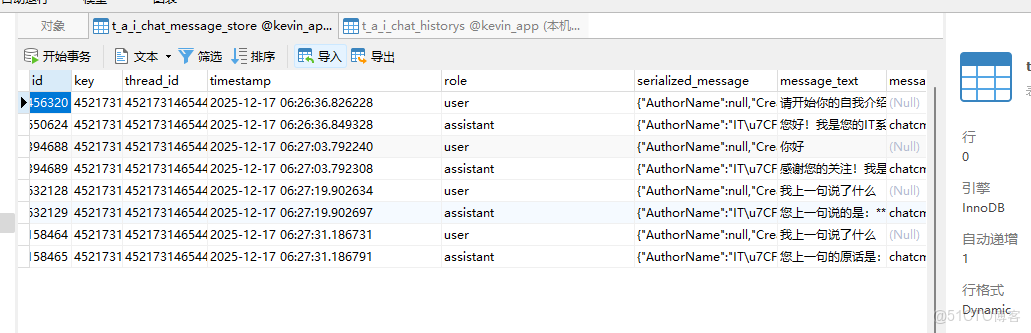
數據庫設計建議
對於關係型數據庫(如 SQL Server),建議的表結構:
/// <summary>
 /// 專門用於存儲AI聊天記錄的表
 /// </summary>
 [Table("TAIChatMessageStore")]
 [Description("專門用於存儲AI聊天記錄的表")]
 [Index(nameof(Key))]
 [Index(nameof(ThreadId))]
 [Index(nameof(Role))]
 [Index(nameof(MessageId))]
 public class TAIChatMessageStore : CUD_User
 {
     [MaxLength(200)]
     public string Key { get; set; }

     [MaxLength(100)]

     public string ThreadId { get; set; }

     [Description("消息時間stamp")]
     public DateTimeOffset? Timestamp { get; set; }

     /// <summary>
     /// 角色標識
     /// </summary>
     [MaxLength(50)]
     public string Role { get; set; }
     public string SerializedMessage { get; set; }
     /// <summary>
     /// 消息內容
     /// </summary>

     public string? MessageText { get; set; }
     /// <summary>
     /// 消息id
     /// </summary>
     [Description("消息id")]
     [MaxLength(100)]
     public string? MessageId { get; set; }
 }
實現數據持久化
- 寫入示例 使用 Entity Framework Core 保存數據:
public async Task AddMessagesAsync(List<ChatHistoryItemDto> chatHistoryItems, CancellationToken cancellationToken)
     {
         var adddata = chatHistoryItems.Select(t => new TAIChatMessageStore
         {
             Id = SnowflakeIdService.GetNextId(),
             CreateTime = DateTime.Now,
             CreateUserId = CurrentUser.UserId,
             IsDelete = false,
             TenantId = CurrentUser.TenantId,
             ThreadId = t.ThreadId,
             Timestamp = t.Timestamp,
             Role = t.Role,
             Key = t.Key,
             SerializedMessage = t.SerializedMessage,
             MessageText = t.MessageText,
             MessageId = t.MessageId
         }).ToList();
         aIChatMessageStoreRp.AddRange(adddata);
         await aIChatMessageStoreRp.SaveChangesAsync();
}- 讀取示例
public Task<List<ChatHistoryItemDto>> GetMessagesAsync(string threadId, CancellationToken cancellationToken)
 {
     return aIChatMessageStoreRp.Query().Where(t => t.ThreadId == threadId && t.IsDelete == false).Select(t => new ChatHistoryItemDto
     {
         Key = t.Key,
         ThreadId = t.ThreadId,
         Timestamp = t.Timestamp,
         SerializedMessage = t.SerializedMessage,
         MessageText = t.MessageText,
         Role = t.Role,
         MessageId = t.MessageId
     }).ToListAsync();
 }
性能優化建議
- 為高頻查詢字段(如
UserId和ChannelId)添加索引 - 實現數據分片策略應對大規模歷史記錄
- 考慮使用 Redis 緩存熱點對話數據
安全注意事項
- 加密存儲敏感對話內容
- 實現數據保留策略定期清理舊記錄
- 遵守 GDPR 等數據隱私法規
測試驗證方法
- 編寫單元測試驗證存儲接口實現
- 使用 Bot Framework Emulator 進行端到端測試
- 進行負載測試驗證性能表現
擴展可能性
- 添加全文檢索支持(如 Azure Cognitive Search)
- 實現跨渠道對話歷史同步
- 開發分析模塊生成對話洞察報告
這種實現方式允許完全控制數據存儲位置和格式,同時保持與 Bot Framework 的兼容性。根據具體需求可選擇 SQL Server、Cosmos DB 或其他數據庫解決方案。
