

題⽬描述
給定⼀個⼆叉搜索樹, 找到該樹中兩個指定節點的最近公共祖先。
- 對於該題的最近的公共祖先定義:對於有根樹T的兩個結點p 、q ,最近公共祖先LCA(T,p,q)表示⼀個結點x ,滿⾜x 是p 和q 的祖先且x 的深度儘可能⼤。在這⾥,⼀個節點也可以是它⾃⼰的祖先.
- ⼆叉搜索樹是若它的左⼦樹不空,則左⼦樹上所有結點的值均⼩於它的根結點的值; 若它的右⼦樹不空,則右⼦樹上所有結點的值均⼤於它的根結點的值
- 所有節點的值都是唯⼀的。
- p 、q 為不同節點且均存在於給定的⼆叉搜索樹中。
如果給定以下搜索⼆叉樹: {7,1,12,0,4,11,14,#,#,3,5} ,如下圖:
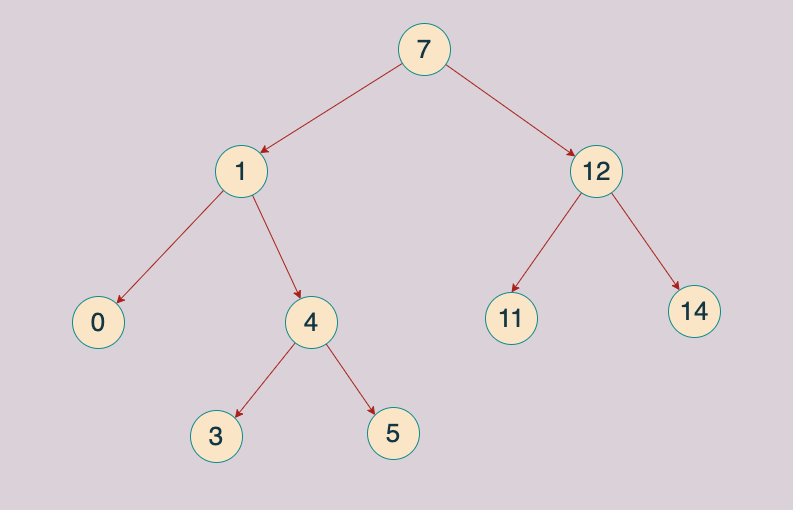
示例1
輸⼊: {7,1,12,0,4,11,14,#,#,3,5},1,12
輸出: 7
説明:節點1 和 節點12的最近公共祖先是7
示例2:
輸⼊: {7,1,12,0,4,11,14,#,#,3,5},12,11
輸出: 12
説明:因為⼀個節點也可以是它⾃⼰的祖先.所以輸出12
思路及解答
迭代遍歷
二叉搜索樹(BST)的特性,通過迭代查找公共祖先,根據節點值大小關係,決定向左子樹或右子樹查找
public class Solution {
    public TreeNode lowestCommonAncestor(TreeNode root, TreeNode p, TreeNode q) {
        if (root == null) return null;

        TreeNode current = root;

        while (current != null) {
            // 如果p和q的值都小於當前節點,LCA在左子樹
            if (p.val < current.val && q.val < current.val) {
                current = current.left;
            }
            // 如果p和q的值都大於當前節點,LCA在右子樹
            else if (p.val > current.val && q.val > current.val) {
                current = current.right;
            }
            // 否則當前節點就是LCA
            else {
                return current;
            }
        }

        return null; // 未找到
    }
}
- 時間複雜度:O(h),h為樹高,平均O(log n),最壞O(n)
- 空間複雜度:O(1),只使用常數空間
遞歸遍歷
遞歸判斷節點值關係,決定向左或右遞歸查找
題⽬已經保證了,兩個節點 p , q 都在樹上,我們取出根節點 7 ,假設⼩於 7 ,則在左⼦樹,如果⼤於7 ,則在右⼦樹。
需要查找的兩個節點,但凡有⼀個等於根節點,它們的⽗節點就是根節點,因為⼀個節點的⽗節點可以是⾃身(題⽬有説明)。
如果⼀個⼤於根節點,⼀個⼩於更節點,其最近公共祖先也是根節點。如果兩個都⼤於,或者兩個都⼩於,怎麼辦?
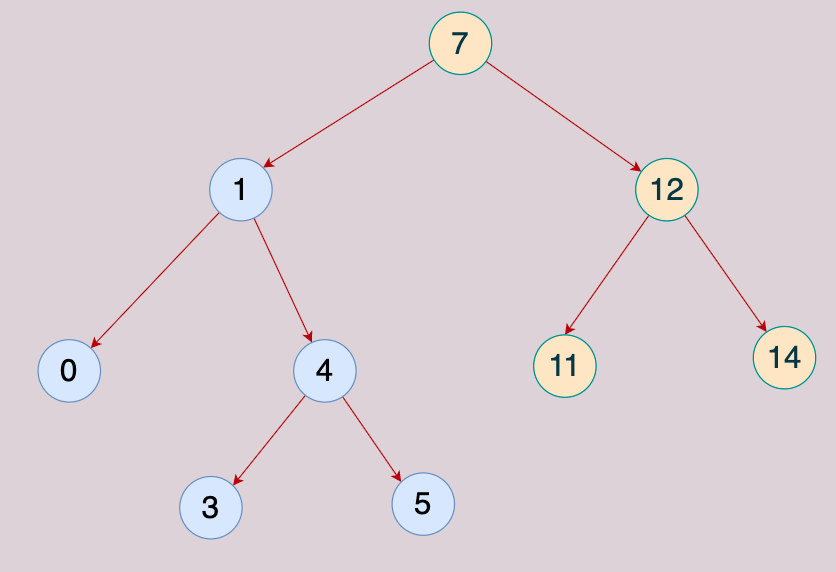
當然是遞歸,如果兩個都⼩於,那麼就取當前的左⼦樹進⾏遞歸,直到符合要求。⽐如查找,3 和 5,由於 3 和 5 都⼩於 7,那麼取左⼦樹 1 下⾯的進⾏遞歸:
class TreeNode {
    int val = 0;
    TreeNode left = null;
    TreeNode right = null;
    public TreeNode(int val) {
        this.val = val;
    }
}
public class Solution68 {
    public int lowestCommonAncestor(TreeNode root, int p, int q) {
        TreeNode result = commonAncestor(root, p, q);
        return result == null ? -1 : result.val;
    }
    public TreeNode commonAncestor(TreeNode root, int p, int q) {
        // 等於空
        if (root == null) {
            return null;
        }
        if (root.val == p || root.val == q) {
            // 有⼀個值等於根節點
            return root;
        }
        // 在左⼦樹
        if (p < root.val && q < root.val) {
            return commonAncestor(root.left, p, q);
        } else if (p > root.val && q > root.val) {
            // 兩個都在右⼦樹
            return commonAncestor(root.right, p, q);
        } else {
            return root;
        }
    }
}
- 時間複雜度:O(h),遞歸深度為樹高
- 空間複雜度:O(h),遞歸調用棧空間
通用二叉樹
假設這道題條件改⼀下,如果不是⼆叉搜索樹,怎麼辦?
如果不是⼆叉搜索樹,那麼我們不能直接判斷出它在左⼦樹,還是在右⼦樹。不如暴⼒點,先在左⼦樹中找,如果右⼦樹沒找到,説明都在左⼦樹,如果左⼦樹沒找到,説明都在右⼦樹,如果兩個都分別存在,説明當前節點就是他們的⽗節點。
public class Solution68 {
    public int lowestCommonAncestor(TreeNode root, int p, int q) {
        TreeNode result = commonAncestor(root, p, q);
        return result == null ? -1 : result.val;
    }
    public TreeNode commonAncestor(TreeNode root, int p, int q) {
        if (null == root) {
            return null;
        }
        if (root.val == p || root.val == q) {
            return root;
        }
        TreeNode left = commonAncestor(root.left, p, q);
        TreeNode right = commonAncestor(root.right, p, q);
        if (left == null) {
            return right;
        } else if (right == null) {
            return left;
        } else {
            return root;
        }
    }
}
- 時間複雜度:O(n),需要遍歷整個樹
- 空間複雜度:O(h),遞歸棧深度
