

推薦使用vscode. 相關的插件:

debug配置文件配置:
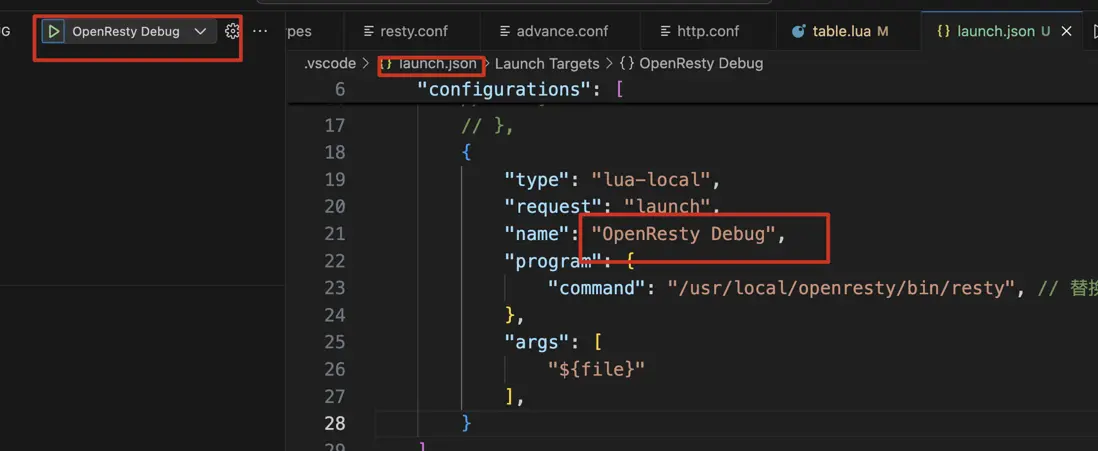
{

    "version": "0.2.0",
    "configurations": [

        {
            "type": "lua-local",
            "request": "launch",
            "name": "OpenResty Debug",
            "program": {
                "command": "/usr/local/openresty/bin/resty", // 替換為你的 resty 路徑
            },
            "args": [
                "${file}"
            ],
        }
    ]
}
啓動/停止方式:
# sudo /usr/local/openresty/bin/openresty -c "`pwd`/hello.conf"
# sudo /usr/local/openresty/bin/openresty -c "`pwd`/hello.conf" -s stop
hello.conf 配置內容:
# sudo /usr/local/openresty/bin/openresty -c "`pwd`/hello.conf"
# sudo /usr/local/openresty/bin/openresty -c "`pwd`/hello.conf" -s stop

worker_processes 1;

# events {}
events {
    worker_connections 512;
}

http {
    server {
        listen 80;
        server_name *.*;

        location / {
            content_by_lua_block {
                ngx.print("hello, world")
            }
        }
        location /echo {
            content_by_lua_block {
                -- 獲取 URL 查詢參數(?a=1&b=2)
                local args = ngx.req.get_uri_args()
                -- 獲取請求頭
                local headers = ngx.req.get_headers()
                -- 返回 JSON 格式的響應
                ngx.header['Content-Type'] = 'application/json'
                ngx.say(
                    require('cjson').encode(
                        {
                            args=args,
                            -- headers=headers,
                            method=ngx.var.request_method,
                            path = ngx.var.request_uri
                        }
                    )
                )

            }
        }
    }
}