

説明
本文基於 jdk 8 編寫。
HashMap 的結構
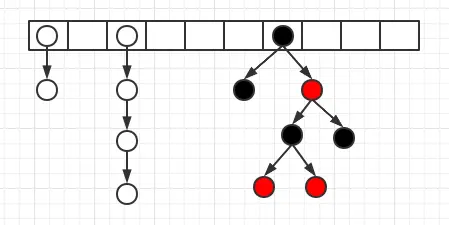
- 圖中的數組是 table 屬性,hashMap 基礎的屬性。一個數組,用於承載 node,table 的每一個格被稱為桶。
- node 是 hashMap 中基礎的 node 節點,用於存儲 key, value。
- 桶位置計算的公式是
(n - 1) & hash,n 指 table 的長度,hash 指 key 的 hash 值。 - 桶位置計算時有可能出現 hash 衝突的現象,在 jdk 1.7 及之前採用的是把 node 拼接成鏈表的方式。但如果 hash 衝突嚴重,桶位置上的鏈表會很長,影響查詢性能。從 jdk 1.8 開始,改成了鏈表 + 紅黑樹的方式,在一個桶位置上元素很多的情況下,樹的查詢效率優於鏈表。
關鍵屬性
table
    /**
     * The table, initialized on first use, and resized as
     * necessary. When allocated, length is always a power of two.
     * (We also tolerate length zero in some operations to allow
     * bootstrapping mechanics that are currently not needed.)
     *
     * hashMap 基礎的屬性。一個數組,用於承載 node,table 的每一個格被稱為桶
     */
    transient Node<K,V>[] table;
Node
    /**
     * Basic hash bin node, used for most entries.  (See below for
     * TreeNode subclass, and in LinkedHashMap for its Entry subclass.)
     *
     * hashMap 中基礎的 node 節點,用於存儲 key, value
     */
    static class Node<K,V> implements Map.Entry<K,V> {
        final int hash;
        final K key;
        V value;
        Node<K,V> next;
    }
modCount
這個屬性與理解 HashMap 的核心流程無關,如果讀者只關心核心流程,可以不用關注。
    /**
     * The number of times this HashMap has been structurally modified
     * Structural modifications are those that change the number of mappings in
     * the HashMap or otherwise modify its internal structure (e.g.,
     * rehash).  This field is used to make iterators on Collection-views of
     * the HashMap fail-fast.  (See ConcurrentModificationException).
     *
     * 用於記錄修改次數,每次增刪改時會維護它的值
     * 在一個迭代器開始的時候,會把 modCount 用一個局部變量 mc 記錄下來。迭代器遍歷完成後,如果發現 modCount 和 mc 不相同,説明迭代期間 hashMap 進行過修改,則拋出異常。
     * 關於迭代器遍歷,可以看一下 EntrySet 內部類的 forEach 方法
     */
    transient int modCount;
關於迭代器遍歷,可以看一下 EntrySet 內部類的 forEach 方法。
    /**
     * 請注意,源碼裏 EntrySet 的其他成員屬性和成員方法,這裏不作展示
     */
    final class EntrySet extends AbstractSet<Map.Entry<K,V>> {
        public final void forEach(Consumer<? super Map.Entry<K,V>> action) {
            Node<K,V>[] tab;
            if (action == null)
                throw new NullPointerException();
            if (size > 0 && (tab = table) != null) {
                // 把 modCount 用一個局部變量 mc 記錄下來
                int mc = modCount;
                for (int i = 0; i < tab.length; ++i) {
                    for (Node<K,V> e = tab[i]; e != null; e = e.next)
                        action.accept(e);
                }
                // 迭代器遍歷完成後,如果發現 modCount 和 mc 不相同,説明迭代期間 hashMap 進行過修改,則拋出異常。
                if (modCount != mc)
                    throw new ConcurrentModificationException();
            }
        }
    }
threshold 擴容閾值
    /**
     * The next size value at which to resize (capacity * load factor).
     *
     * 擴容閾值,由 capacity * loadFactor 得到。決定何時 hashMap 執行 resize 方法擴容
     *
     * @serial
     */
    // (The javadoc description is true upon serialization.
    // Additionally, if the table array has not been allocated, this
    // field holds the initial array capacity, or zero signifying
    // DEFAULT_INITIAL_CAPACITY.)
    int threshold;
loadFactor 加載因子
    /**
     * The load factor for the hash table.
     *
     * 加載因子,決定了 hashMap 實際能存儲的元素容量
     *
     * @serial
     */
    final float loadFactor;

    /**
     * The load factor used when none specified in constructor.
     *
     * 默認的 loadFactor 加載因子
     */
    static final float DEFAULT_LOAD_FACTOR = 0.75f;
加載因子是表示 HashMap 中元素的填滿的程度。加載因子的目的是,為了降低 HashMap 中的 hash 衝突機率,防止大量 node 都因為 hash 衝突變成了鏈表或樹,同時平衡佔用的空間開銷。
加載因子越大,填滿的元素越多。優點是,空間利用率高了。缺點是,hash 衝突的機會加大了。
加載因子越小,填滿的元素越少。優點是,衝突的機會減小了。缺點是,空間浪費多了。
默認的加載因子 DEFAULT_LOAD_FACTOR = 0.75f 算是在 hash 衝突機率與空間開銷間做了取捨平衡。
構造方法
    /**
     * Constructs an empty <tt>HashMap</tt> with the specified initial
     * capacity and the default load factor (0.75).
     *
     * @param  initialCapacity the initial capacity. 初始容量,由 capacity * loadFactor 可以得到擴容閾值 threshold
     * @throws IllegalArgumentException if the initial capacity is negative.
     */
    public HashMap(int initialCapacity) {
        this(initialCapacity, DEFAULT_LOAD_FACTOR);
    }
我們可以注意到,HashMap 裏並沒有 capacity 這個屬性,我們在構造方法中傳入的 capacity,其實會經過 capacity * loadFactor 計算,得到擴容閾值 threshold。
put 方法
    /**
     * Associates the specified value with the specified key in this map.
     * If the map previously contained a mapping for the key, the old
     * value is replaced.
     *
     * put 方法,調用 Val 給指定的 key 添加對應的 value
     *
     * @param key key with which the specified value is to be associated
     * @param value value to be associated with the specified key
     * @return the previous value associated with <tt>key</tt>, or
     *         <tt>null</tt> if there was no mapping for <tt>key</tt>.
     *         (A <tt>null</tt> return can also indicate that the map
     *         previously associated <tt>null</tt> with <tt>key</tt>.)
     */
    public V put(K key, V value) {
        // 第一個 boolean false 表示:當要 put 的 key 在 hashMap 中已存在時,會直接覆蓋原有 value。第二個 boolean true 不用關心,與主流程無關。
        return putVal(hash(key), key, value, false, true);
    }
putVal
    /**
     * Implements Map.put and related methods.
     *
     * @param hash hash for key
     * @param key the key
     * @param value the value to put
     * @param onlyIfAbsent if true, don't change existing value  如果目標 key 在 hashMap 中已經存在,則不會覆蓋原有的 value
     * @param evict if false, the table is in creation mode. 不用關心,與主流程無關
     * @return previous value, or null if none
     */
    final V putVal(int hash, K key, V value, boolean onlyIfAbsent,
                   boolean evict) {
        Node<K,V>[] tab; Node<K,V> p; int n, i;
        // 如果 table 還沒有初始化,則初始化 table
        if ((tab = table) == null || (n = tab.length) == 0)
            n = (tab = resize()).length;
        // 桶位置計算公式: (n - 1) & hash。如果定位到的桶位置為空,則把 node 插入桶位置。p 指向桶位置
        if ((p = tab[i = (n - 1) & hash]) == null)
            tab[i] = newNode(hash, key, value, null);
        // 桶位置不為空,説明出現 hash 碰撞,走 else 分支
        else {
            Node<K,V> e; K k;
            // 通過 key 的 hash 值和 equals 方法判斷桶位置上的 key 是否相同。如果相同則用 e 指向這個節點
            if (p.hash == hash &&
                ((k = p.key) == key || (key != null && key.equals(k))))
                e = p;
            // 判斷桶位置上是否是一棵樹,如果是一棵樹,則調用樹添加元素的方法,然後用 e 指向樹上的這個節點
            else if (p instanceof TreeNode)
                e = ((TreeNode<K,V>)p).putTreeVal(this, tab, hash, key, value);
            // 不是樹,則説明是鏈表
            else {
                // 迭代鏈表,binCount 是鏈表長度計數
                for (int binCount = 0; ; ++binCount) {
                    // 用 e 指向本次迭代的當前元素。如果本次迭代,當前元素為空,即到達了鏈表的尾部
                    if ((e = p.next) == null) {
                        // 向鏈表尾部追加 node
                        p.next = newNode(hash, key, value, null);
                        // 如果鏈表長度達到了閾值,把鏈表轉換成樹。鏈表轉換樹的閾值無法修改,因為是 final 修飾的。
                        if (binCount >= TREEIFY_THRESHOLD - 1) // -1 for 1st
                            treeifyBin(tab, hash);
                        break;
                    }
                    // 通過 key 的 hash 值和 equals 方法判斷本次迭代的 key 是否相同。如果相同則用 e 指向這個節點。然後停止迭代鏈表。
                    if (e.hash == hash &&
                        ((k = e.key) == key || (key != null && key.equals(k))))
                        break;
                    // 維護當前元素,準備下一次迭代
                    p = e;
                }
            }
            // 如果 e 不為空,説明要添加的 key 原先已存在於這個桶位置上,覆蓋原有 value。這裏體現了 hashMap 的 onlyIfAbsent 選項為 false 時,出現 key 相同時,會直接覆蓋原有 value
            if (e != null) { // existing mapping for key
                V oldValue = e.value;
                // onlyIfAbsent 選項為 false 時,或原有 value 為 null 時,會直接覆蓋原有 value
                if (!onlyIfAbsent || oldValue == null)
                    e.value = value;
                // 這個方法不用關心。留給 LinkedHashMap 回調用。
                afterNodeAccess(e);
                // 返回原有的 value
                return oldValue;
            }
        }
        // 維護修改次數計數
        ++modCount;
        // 如果達到了擴容閾值,則 resize
        if (++size > threshold)
            resize();
        // 這個方法不用關心。留給 LinkedHashMap 回調用。
        afterNodeInsertion(evict);
        // 沒有找到 key 對應的 value,返回 null
        return null;
    }
有一個細節,鏈表轉換樹的閾值 TREEIFY_THRESHOLD 無法修改,因為是 final 修飾的,之前面試被問到過。
    /**
     * The bin count threshold for using a tree rather than list for a
     * bin.  Bins are converted to trees when adding an element to a
     * bin with at least this many nodes. The value must be greater
     * than 2 and should be at least 8 to mesh with assumptions in
     * tree removal about conversion back to plain bins upon
     * shrinkage.
     *
     * 鏈表轉換樹的閾值,無法修改,因為是 final 修飾的
     */
    static final int TREEIFY_THRESHOLD = 8;
get 方法
    /**
     * Returns the value to which the specified key is mapped,
     * or {@code null} if this map contains no mapping for the key.
     *
     * <p>More formally, if this map contains a mapping from a key
     * {@code k} to a value {@code v} such that {@code (key==null ? k==null :
     * key.equals(k))}, then this method returns {@code v}; otherwise
     * it returns {@code null}.  (There can be at most one such mapping.)
     *
     * <p>A return value of {@code null} does not <i>necessarily</i>
     * indicate that the map contains no mapping for the key; it's also
     * possible that the map explicitly maps the key to {@code null}.
     * The {@link #containsKey containsKey} operation may be used to
     * distinguish these two cases.
     *
     * @see #put(Object, Object)
     */
    public V get(Object key) {
        Node<K,V> e;
        // 根據指定的 key 查找 node,返回 node 的 value
        return (e = getNode(hash(key), key)) == null ? null : e.value;
    }
getNode
    /**
     * Implements Map.get and related methods.
     *
     * 根據指定的 key,查找 node
     *
     * @param hash hash for key
     * @param key the key
     * @return the node, or null if none
     */
    final Node<K,V> getNode(int hash, Object key) {
        Node<K,V>[] tab; Node<K,V> first, e; int n; K k;
        // 如果 table 不為空,且根據 key 對應到的桶位置不為空
        if ((tab = table) != null && (n = tab.length) > 0 &&
            (first = tab[(n - 1) & hash]) != null) {
            // 通過 key 的 hash 值和 equals 方法判斷桶位置上的 key 是否相同
            if (first.hash == hash && // always check first node
                ((k = first.key) == key || (key != null && key.equals(k))))
                // 和目標 key 相同,返回當前節點
                return first;
            // 桶位置不為空,説明可能存在 hash 碰撞,判斷桶位置上的元素是否有下一個節點
            if ((e = first.next) != null) {
                // 判斷桶位置上是否是一棵樹,如果是一棵樹,則調用樹查找元素的方法
                if (first instanceof TreeNode)
                    return ((TreeNode<K,V>)first).getTreeNode(hash, key);
                // 不是樹,則説明是鏈表,迭代鏈表
                do {
                    // 通過 key 的 hash 值和 equals 方法判斷本次迭代的 key 是否相同
                    if (e.hash == hash &&
                        ((k = e.key) == key || (key != null && key.equals(k))))
                        // 和目標 key 相同,返回當前節點
                        return e;
                } while ((e = e.next) != null);
            }
        }
        // 沒有找到 key 對應的元素,返回 null
        return null;
    }
resize 方法
常見的執行 resize() 方法的兩種情況
在 HashMap 的 putVal 方法中,如果 table 未初始化,則會執行resize(),然後就初始化table。初始化 table 由 resize 負責。
// 如果 table 還沒有初始化,則初始化 table
if ((tab = table) == null || (n = tab.length) == 0)
    n = (tab = resize()).length;
在 HashMap 的 putVal 方法中,存儲的數據量大於 threshold 時,會執行 resize() 方法。
        // 如果 hashMap 中的元素數量達到了擴容閾值,則 resize
        if (++size > threshold)
            resize();
在putVal()方法中,size表示當前HashMap的數據量,如果size大於threshold,則會執行該方法,進行擴容操作。
resize 方法源碼
    /**
     * Initializes or doubles table size.  If null, allocates in
     * accord with initial capacity target held in field threshold.
     * Otherwise, because we are using power-of-two expansion, the
     * elements from each bin must either stay at same index, or move
     * with a power of two offset in the new table.
     *
     * 初始化 hashMap 或給 hashMap 的 table 擴容兩倍
     *
     * @return the table
     */
    final Node<K,V>[] resize() {
        // oldTab 指向舊 table
        Node<K,V>[] oldTab = table;
        // 舊 table 的長度
        int oldCap = (oldTab == null) ? 0 : oldTab.length;
        // oldThr 表示舊的擴容閾值 threshold。threshold = 數組長度 * 負載因子
        int oldThr = threshold;
        int newCap, newThr = 0;
        if (oldCap > 0) {
            // 當舊 table 的長度大於最大容量時的處理
            if (oldCap >= MAXIMUM_CAPACITY) {
                threshold = Integer.MAX_VALUE;
                return oldTab;
            }
            // 如果舊的數組長度 * 2 後小於 int 的最大值,並且舊的數組長度大於 16
            else if ((newCap = oldCap << 1) < MAXIMUM_CAPACITY &&
                     oldCap >= DEFAULT_INITIAL_CAPACITY)
                // 擴容閾值 * 2
                newThr = oldThr << 1; // double threshold
        }
        // 如果舊的 threshold 大於 0,初始容量設置為舊的 threshold。這裏在 table 初始化時會用到
        else if (oldThr > 0) // initial capacity was placed in threshold
            newCap = oldThr;
        // 擴容閾值為 0 表示使用默認值,DEFAULT_INITIAL_CAPACITY = 16,DEFAULT_LOAD_FACTOR = 0.75,因此默認的擴容閾值為 12
        else {               // zero initial threshold signifies using defaults
            newCap = DEFAULT_INITIAL_CAPACITY;
            newThr = (int)(DEFAULT_LOAD_FACTOR * DEFAULT_INITIAL_CAPACITY);
        }
        // 擴容閾值為 0 時的邊界條件處理
        if (newThr == 0) {
            float ft = (float)newCap * loadFactor;
            newThr = (newCap < MAXIMUM_CAPACITY && ft < (float)MAXIMUM_CAPACITY ?
                      (int)ft : Integer.MAX_VALUE);
        }
        // 將計算後得出的閾值賦值給 threshold 屬性
        threshold = newThr;
        // 不用關心這個註解。這個註解在屏蔽一些無關緊要的警告,使開發者能看到一些他們真正關心的警告,降低開發者的心智負擔。
        // 創建一個新的 table,供擴容後使用
        @SuppressWarnings({"rawtypes","unchecked"})
        Node<K,V>[] newTab = (Node<K,V>[])new Node[newCap];
        // 把新 table 賦值給 hashMap 的屬性
        table = newTab;
        // 如果舊 table 不為空,開始擴容
        if (oldTab != null) {
            // 迭代遍歷舊 table
            for (int j = 0; j < oldCap; ++j) {
                Node<K,V> e;
                // e 指向當前桶位置的元 node,當前桶位置的 node 不為空時
                if ((e = oldTab[j]) != null) {
                    // 清空舊 table 的當前桶位置
                    oldTab[j] = null;
                    if (e.next == null)
                        // 如果當前桶位置的 node 不是鏈表不是紅黑樹,則根據桶位置計算公式,重新分配 node 的桶位置
                        newTab[e.hash & (newCap - 1)] = e;
                    // 如果當前桶位置的 node 是樹,則使用樹的方式,把舊樹上的 node,重新分配到新的樹中
                    else if (e instanceof TreeNode)
                        ((TreeNode<K,V>)e).split(this, newTab, j, oldCap);
                    // 不是樹,則是鏈表
                    else { // preserve order
                        // 把鏈表中的所有節點分成兩條鏈表
                        // 一條鏈表的 node 是不需要更換 table 下標的
                        Node<K,V> loHead = null, loTail = null;
                        // 一條鏈表的 node 是需要更換 table 下標的
                        Node<K,V> hiHead = null, hiTail = null;
                        Node<K,V> next;
                        // 迭代遍歷鏈表
                        do {
                            next = e.next;
                            // 如果 e.hash & oldCap 進行二進制與運算,算出的結果為 0,即説明該 node 所對應的數組下標不需要改變。把該 node 追加到 loHead 鏈表上
                            if ((e.hash & oldCap) == 0) {
                                if (loTail == null)
                                    loHead = e;
                                else
                                    loTail.next = e;
                                loTail = e;
                            }
                            // 否則説明該 node 所對應的數組下標需要改變。把該 node 追加到 hiHead 鏈表上
                            else {
                                if (hiTail == null)
                                    hiHead = e;
                                else
                                    hiTail.next = e;
                                hiTail = e;
                            }
                        } while ((e = next) != null);
                        // 如果不需要更換 table 下標的 node 鏈表 -- loTail 不為空,則把 loTail 放在當前桶位置上
                        if (loTail != null) {
                            loTail.next = null;
                            newTab[j] = loHead;
                        }
                        // 如果需要更換 table 下標的 node 鏈表 -- hiTail 不為空,則把 hiTail 放到新的桶位置上。並且計算公式是把當前 table 下標直接 + 舊 table 的長度
                        if (hiTail != null) {
                            hiTail.next = null;
                            newTab[j + oldCap] = hiHead;
                        }
                    }
                }
            }
        }
        // 返回新創建的 table
        return newTab;
    }
兩個個公式
(e.hash & oldCap) == 0 判斷是否需要重新分配桶位置
e 是當前 node,oldCap 是舊數組的長度。這個公式算出的結果為 0,説明該 node (即 e)所對應的數組下標不需要改變。結果不為 0,説明該 node 所對應的數組下標需要改變。
(e.hash & oldCap) == 0 為什麼能判斷出是否需要重新分配桶位置?
這個公式是推導出來的,推導過程是數學,我們不需要關注。如果想了解此公式的推導請見:HashMap擴容時的rehash方法中(e.hash & oldCap) == 0算法推導
j + oldCap 桶位置重分配公式
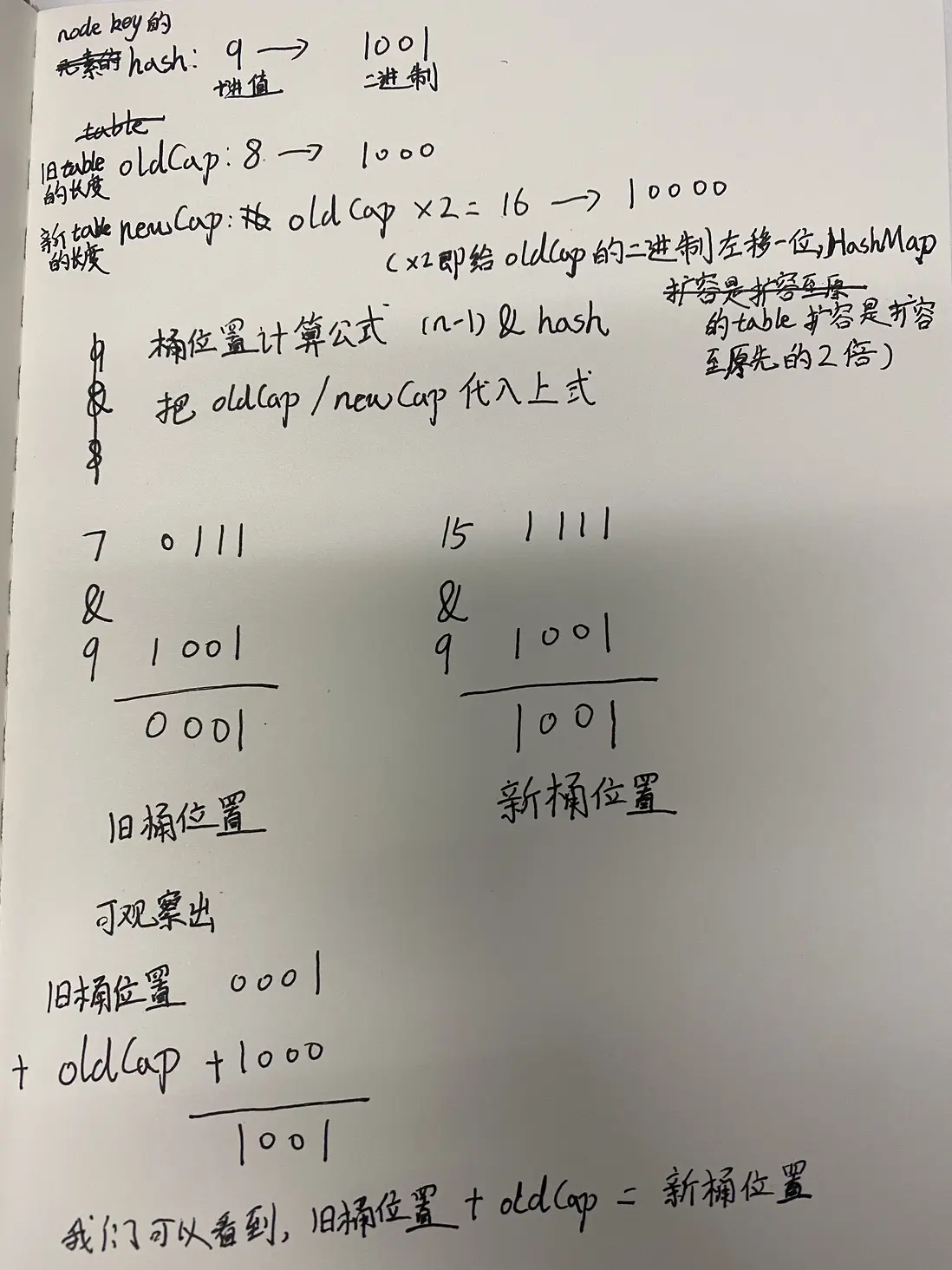
j 是 node 的舊桶位置,oldCap 是舊 table 的長度。即 舊桶位置 + 舊 table 的長度。得到這個公式的運算結果,是擴容後該元素的新桶位置。可以理解為是桶位置重新分配的公式。
為什麼這樣能得到呢?我們來舉例回答一下。
現在我們有一個 node key 的 hash 值是 9,對應的二進制位。舊 table 的長度 oldCap 是 8,新 table 的長度 newCap 是 16。以下是手寫演算驗證:
為什麼 HashMap 擴容是 2 倍?
通過本文桶位置重新分配的公式 j + oldCap 手寫驗證,我們可以看出,當 HashMap 擴容兩倍的時候,剛好可以用到 桶位置重新分配的公式 j + oldCap,加快計算重分配後的桶位置。同時,newCap = oldCap << 1 新 table 長度 = 舊 table 長度在二進制上左移一位,這樣的位運算也很高效。
其實這裏擴容倍數和桶位置重分配公式的配合,能體現出作者縝密的思考和深厚的數學功底。
