

對於神經網絡來説,我們已經習慣了層狀網絡的思維:數據進來,經過第一層,然後第二層,第三層,最後輸出結果。這個過程很像流水線,每一步都是離散的。
但是現實世界的變化是連續的,比如燒開水,誰的温度不是從30度直接跳到40度,而是平滑的上生。球從山坡滾下來速度也是漸漸加快的。這些現象背後都有連續的規律在支配。
微分方程就是描述這種連續變化的語言。它不關心某個時刻的具體數值,而是告訴你"變化的速度"。比如説,温度下降得有多快?球加速得有多猛?
Neural ODE的想法很直接:自然界是連續的,神經網絡要是離散的?與其讓數據在固定的層之間跳躍,不如讓它在時間維度上平滑地演化。
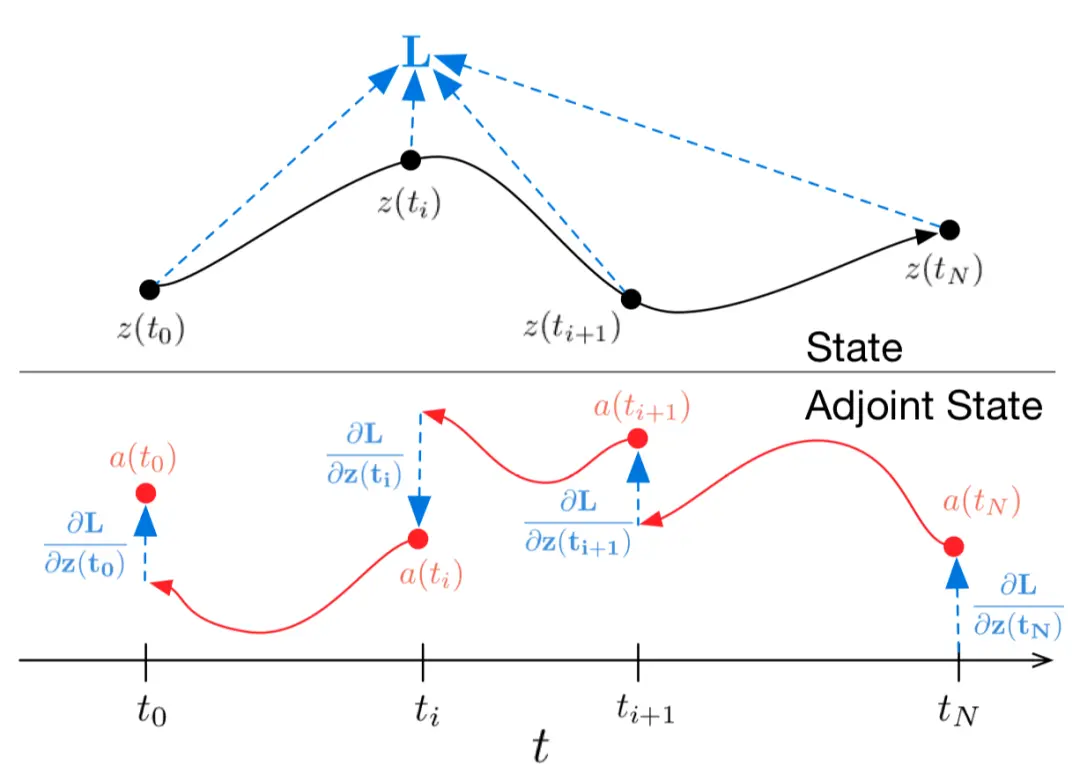
微分方程的概念
微分方程其實就是描述變化的規則。
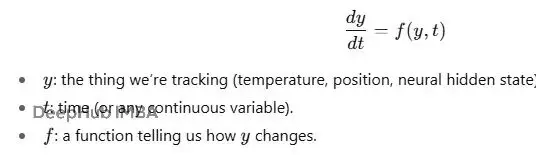
最簡單的例子是咖啡冷卻。剛泡好的咖啡温度高,冷卻很快;温度接近室温時,冷卻就變慢了。這個現象背後的規律是:冷卻速度和温度差成正比。
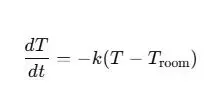
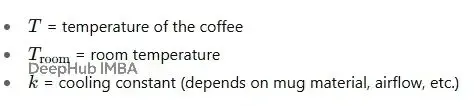
比如説:90°C的咖啡在22°C房間裏,温差68度,冷卻很快;30°C的咖啡在同樣環境裏,温差只有8度,冷卻就慢得多。這就是為什麼咖啡從燙嘴快速降到能喝的温度,然後就一直保持温熱狀態。
這不只是個咖啡的故事,它展示了動態系統的核心特徵:當前狀態決定了變化的方向和速度。ODE捕捉的正是這種連續演化的規律。
 # 1) 咖啡冷卻曲線(指數衰減到室温)

import numpy as np
import matplotlib.pyplot as plt

# 咖啡冷卻曲線 ----------
# 冷卻模型參數:dT/dt = -k (T - T_room)
T0 = 90.0          # 初始温度 (°C)
T_room = 22.0      # 室温 (°C)
k = 0.35           # 冷卻常數 (1/min)
t = np.linspace(0, 20, 300)  # 分鐘

T = T_room + (T0 - T_room) * np.exp(-k * t)

plt.figure(figsize=(7, 5))
plt.plot(t, T, linewidth=2)
plt.title("Coffee Cooling: An ODE in Action")
plt.xlabel("Time (minutes)")
plt.ylabel("Temperature (°C)")
plt.grid(True, alpha=0.3)
coffee_path = "/data/coffee_cooling_curve.png"
plt.tight_layout()
plt.savefig(coffee_path, dpi=200, bbox_inches="tight")
 plt.show()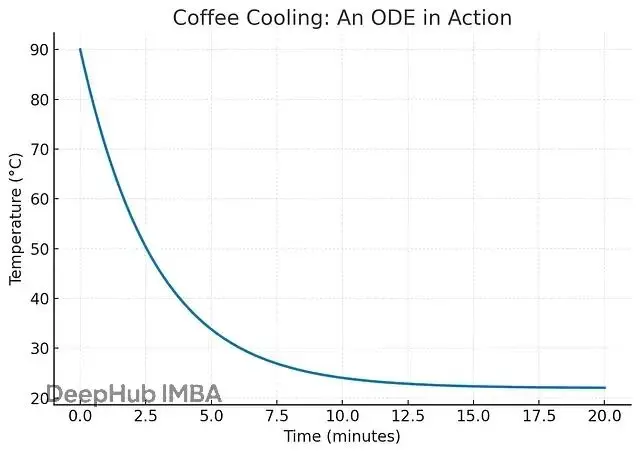
另一個例子是球滾下山坡。球剛開始幾乎不動,但重力會讓它加速。滾得越快摩擦阻力越大,最終速度會趨於穩定。整個過程可以用一個ODE來描述:
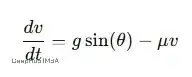
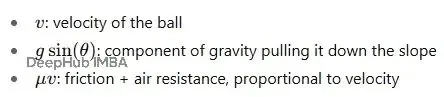
這個方程抓住了兩個關鍵力量:重力讓球加速、摩擦讓球減速,速度的變化取決於這兩個力的平衡。從數學上看,這個簡單的方程能完整地描述球從靜止到終端速度的整個過程。
    import numpy as np
    import matplotlib.pyplot as plt

    # ---------------- 參數 ----------------
    g = 9.81           # 重力 (m/s^2)
    theta_deg = 15.0   # 坡度角(度)
    theta = np.deg2rad(theta_deg)
    mu = 0.4           # 線性阻力系數 (1/s)

    v0 = 0.0           # 初始速度 (m/s)
    x0 = 0.0           # 初始位置 (m)
    t_end = 12.0       # 總仿真時間 (s)
    n_steps = 1200     # 積分步數

# ---------------- 時間網格 ----------------
t = np.linspace(0.0, t_end, n_steps)

# ---------------- 向量場 ----------------
def f(y, ti):
    x, v = y
    dv = g*np.sin(theta) - mu*v
    dx = v
    return np.array([dx, dv], dtype=float)

# ---------------- RK4積分器 ----------------
def rk4(f, y0, t):
    y = np.zeros((len(t), len(y0)), dtype=float)
    y[0] = y0
    for i in range(1, len(t)):
        h = t[i] - t[i-1]
        ti = t[i-1]
        yi = y[i-1]
        k1 = f(yi, ti)
        k2 = f(yi + 0.5*h*k1, ti + 0.5*h)
        k3 = f(yi + 0.5*h*k2, ti + 0.5*h)
        k4 = f(yi + h*k3, ti + h)
        y[i] = yi + (h/6.0)*(k1 + 2*k2 + 2*k3 + k4)
    return y

# ---------------- 數值積分 ----------------
y0 = np.array([x0, v0])
traj = rk4(f, y0, t)
x_num = traj[:, 0]
v_num = traj[:, 1]

# ---------------- 解析解 ----------------
v_inf = (g*np.sin(theta)) / mu if mu != 0 else np.inf
v_ana = v_inf + (v0 - v_inf) * np.exp(-mu * t)
x_ana = x0 + v_inf*t + ((v0 - v_inf)/mu) * (1.0 - np.exp(-mu*t))

# ---------------- 圖1:速度 ----------------
plt.figure(figsize=(8.5, 5))
plt.plot(t, v_num, linewidth=2, label="Velocity — RK4 (numeric)")
plt.plot(t, v_ana, linewidth=2, linestyle="--", label="Velocity — analytic")
plt.axhline(v_inf, linestyle=":", label=f"Terminal velocity = {v_inf:.2f} m/s")
plt.title(f"Ball Rolling Downhill — Velocity vs Time (θ={theta_deg:.1f}°, μ={mu})")
plt.xlabel("Time (s)")
plt.ylabel("Velocity (m/s)")
plt.grid(True, alpha=0.3)
plt.legend(frameon=False)
plt.tight_layout()
vel_png = "/mnt/data/ball_downhill_velocity.png"
vel_svg = "/mnt/data/ball_downhill_velocity.svg"
plt.savefig(vel_png, dpi=220, bbox_inches="tight")
plt.savefig(vel_svg, bbox_inches="tight")
plt.show()

# ---------------- 圖2:位置 ----------------
plt.figure(figsize=(8.5, 5))
plt.plot(t, x_num, linewidth=2, label="Position — RK4 (numeric)")
plt.plot(t, x_ana, linewidth=2, linestyle="--", label="Position — analytic")
plt.title(f"Ball Rolling Downhill — Position vs Time (θ={theta_deg:.1f}°, μ={mu})")
plt.xlabel("Time (s)")
plt.ylabel("Position along slope (m)")
plt.grid(True, alpha=0.3)
plt.legend(frameon=False)
plt.tight_layout()
pos_png = "/mnt/data/ball_downhill_position.png"
pos_svg = "/mnt/data/ball_downhill_position.svg"
plt.savefig(pos_png, dpi=220, bbox_inches="tight")
plt.savefig(pos_svg, bbox_inches="tight")
plt.show()

 vel_png, vel_svg, pos_png, pos_svg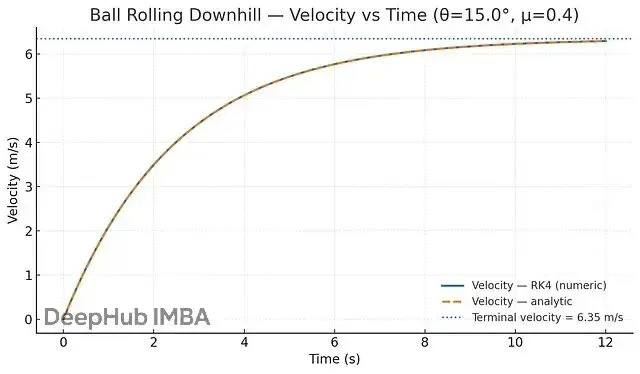
重力把球往下拉,速度快速上升,但摩擦力越來越大,最終達到終端速度。ODE完美地捕捉了這個平滑的過程。
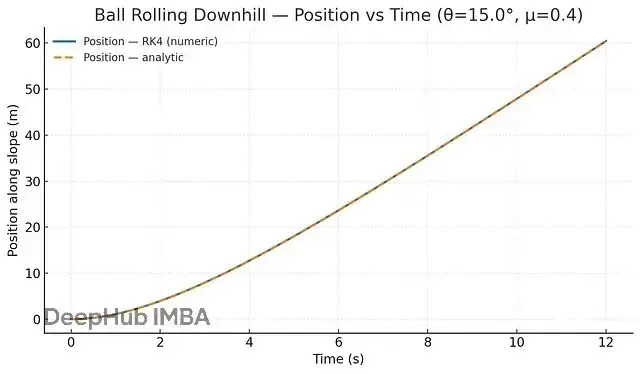
位置的變化也是如此:開始緩慢,然後加速,最後幾乎勻速。這提醒我們,自然界的運動是連續的流,而不是離散的跳躍。
從深度網絡到ODE
傳統深度學習是離散的:

比如説ResNet的每一層都在做同樣事:取當前隱藏狀態,加上一些變換,然後傳遞給下一層。這和數值求解ODE的歐拉方法非常相似——通過小步長逼近連續變化。
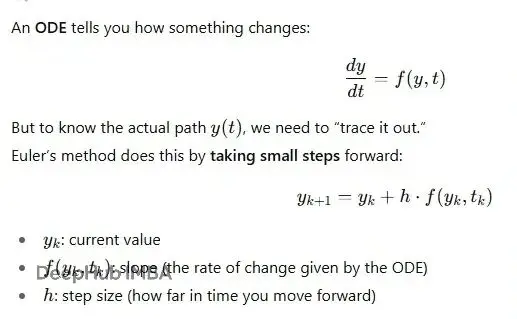
或者可以説ResNet其實就是ODE的離散化版本。
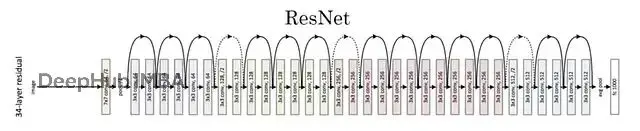
更多層應該帶來更強的學習能力。但實際上網絡太深反而性能下降,原因是梯度消失——學習信號在層層傳遞中變得越來越弱。
ResNet的關鍵發現是是引入殘差學習。不要求每層學習完整的變換,而是學習一個"修正項":
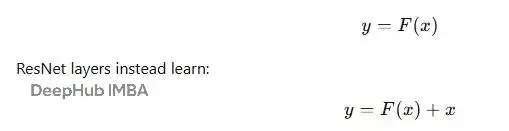
F(x)是殘差,x是跳躍連接傳遞的原始輸入。簡單的説:保留原來的信息,只學習需要調整的部分。
跳躍連接字面上就是把輸入x加到輸出上,這讓梯度能更容易地向後傳播也防止了信息丟失。通過這個技巧,凱明大佬訓練了152層的網絡,ResNet不僅贏了2015年的ImageNet競賽,也成為了現代計算機視覺的基礎框架。
這是一個簡單的ResNet塊實現:
 import torch.nn as nn

# 定義單個ResNet"塊"
# 每個塊學習殘差函數F(x),然後在最後將輸入x加回
class ResNetBlock(nn.Module):
    def __init__(self, in_channels, out_channels):
        super().__init__()

        # 第一個卷積層:
        # - 應用3x3濾波器從輸入中提取特徵
        # - padding=1確保輸出大小與輸入相同
        self.conv1 = nn.Conv2d(in_channels, out_channels, kernel_size=3, padding=1)

        # 非線性:ReLU將非線性模式引入網絡
        self.relu  = nn.ReLU()

        # 第二個卷積層:
        # - 另一個3x3濾波器來細化特徵
        # - 仍然保持空間大小不變
        self.conv2 = nn.Conv2d(out_channels, out_channels, kernel_size=3, padding=1)

    def forward(self, x):
        # 將輸入保存為'殘差'
        # 這將在稍後通過跳躍連接加回
        residual = x

        # 通過第一個卷積 + ReLU激活傳遞輸入
        out = self.relu(self.conv1(x))

        # 通過第二個卷積傳遞(還沒有激活)
        out = self.conv2(out)

        # 將原始輸入(殘差)加到輸出上
        # 這是使ResNet特殊的"跳躍連接"
        out = out + residual

        # 再次應用ReLU以僅保留正激活
         return self.relu(out)
關鍵在最後一行:返回的不是out,而是out + residual。這就是ResNet的精髓。
Neural ODE的核心思想
常規深度網絡中,數據要經過固定數量的層。網絡深度必須在訓練前確定——10層、50層還是100層?Neural ODE徹底改變了這個思路。
不再用離散的層,而是讓網絡的隱藏狀態在時間維度上連續演化。不是"通過100層處理輸入",而是"從初始隱藏狀態開始,讓它按照某個規則連續演化"。
要知道隱藏狀態在某個時刻的樣子,就用ODE求解器,這個算法會問:狀態變化有多快?需要多精確?步長應該多大?
這帶來了一個關鍵特性:自適應深度。標準網絡的深度是固定的,但Neural ODE中求解器自己決定需要多少步。簡單數據用幾步就夠了,複雜數據就多用幾步,網絡在計算過程中自動調整"深度"。
Neural ODE的幾個優勢:
內存效率:不需要存儲所有中間激活,只要起點和終點。
自適應計算:簡單問題少用計算,複雜問題多用計算。
連續建模:天然適合物理、生物、金融等連續變化的系統。
可逆性:對生成模型特別有用。
構建Neural ODE
torchdiffeq是PyTorch的Neural ODE庫:
 pip install torchdiffeq
 import torch
 import torch.nn as nn
 from torchdiffeq import odeint
定義ODE的動力學函數:
 import torch
import torch.nn as nn

class ODEFunc(nn.Module):
    def __init__(self):
        super().__init__()
        # 定義參數化f_theta(h)的神經網絡
        # 輸入:h(大小為2的狀態向量)
        # 輸出:dh/dt(h的變化率,也是大小2)
        self.net = nn.Sequential(
            nn.Linear(2, 50),   # 層:從2D狀態 -> 50個隱藏單元
            nn.Tanh(),          # 非線性激活以獲得靈活性
            nn.Linear(50, 2)    # 層:從50個隱藏單元 -> 2D輸出
        )

    def forward(self, t, h):
        """
        ODE函數的前向傳播。
        參數:
            t : 當前時間(標量,odeint需要但這裏未使用)
            h : 當前狀態(形狀為[batch_size, 2]的張量)
        返回:
            dh/dt : h的估計變化率(與h形狀相同)
        """
         return self.net(h)
這裏f(h, t, θ)是個小神經網絡,它描述了隱藏狀態如何隨時間變化。
設置初始狀態和時間:
 h0 = torch.tensor([[2., 0.]])   # 起始點
 t = torch.linspace(0, 25, 100)  # 時間步長
 func = ODEFunc()   # 你的神經ODE動力學(dh/dt = f(h))
求解ODE:
 trajectory = odeint(func, h0, t)
 print(trajectory.shape)  # (時間, 批次, 特徵)
這樣我們就把神經網絡轉換成了連續系統。
案例研究:捕食者-獵物動力學
這是個經典的生態學問題。雪兔和加拿大猞猁的種羣數量呈現週期性變化:兔子多了,猞猁有足夠食物,數量增加;猞猁多了,兔子被吃得多,數量下降;兔子少了,猞猁沒東西吃,數量也下降;猞猁少了,兔子又開始繁盛...這個循環不斷重複。
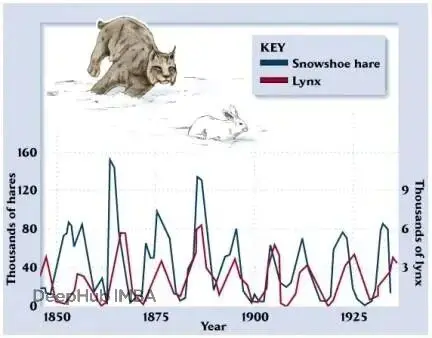
這種動力學天然適合用微分方程建模,Neural ODE可以直接從歷史數據中學習這個系統的演化規律,產生平滑的軌跡,並預測未來的種羣變化。
為什麼捕食者-獵物系統適合用ODE建模?
連續變化:種羣不會突然跳躍,而是隨着動物的出生、死亡平滑變化。
相互依賴:獵物的增長率不只取決於自身繁殖,還取決於捕食者數量。捕食者的生存也依賴獵物的可獲得性。

這裏H是兔子,L是猞猁,a是獵物出生率,b是捕食率,c是捕食者死亡率,d是捕食者繁殖率。
反饋循環:更多獵物→捕食者增長→獵物衰落→捕食者餓死→獵物恢復→週期繼續。這些反饋自然形成ODE系統。
預測能力:通過求解方程,我們不僅能描述過去的週期,還能預測或模擬不同條件下的演化。
代碼實現
 !pip -q install torchdiffeq statsmodels
import math, numpy as np, torch, torch.nn as nn
import matplotlib.pyplot as plt
from torchdiffeq import odeint
from statsmodels.datasets import sunspots
DEVICE = "cuda" if torch.cuda.is_available() else "cpu"
torch.manual_seed(1337)
np.random.seed(1337)
 print("Device:", DEVICE)
加載哈德遜灣公司的歷史數據(1900-1920年的毛皮貿易記錄):
# 真實年度毛皮計數(種羣的代理),1900-1920(21年)
years = np.arange(1900, 1921, dtype=np.int32)

# 來自經典生態學教科書(四捨五入)
hares = np.array([30, 47.2, 70.2, 77.4, 36.3, 20.6, 18.1, 21.4, 22.0, 25.4,
                  27.1, 40.3, 57.0, 76.6, 52.3, 19.5, 11.2,  7.6, 14.6, 16.2, 24.7], dtype=np.float32)
lynx  = np.array([ 4,  6.1,  9.8, 35.2, 59.4, 41.7, 19.0, 13.0,  8.3,  9.1,
                  10.8, 12.6, 16.8, 20.6, 18.1,  8.0,  5.3,  3.8,  4.0,  6.5,  8.0], dtype=np.float32)

assert len(years) == len(hares) == len(lynx)
N = len(years)
print(f"Years {years[0]}–{years[-1]} (N={N})")

# 將數據放入張量並輕度標準化。
# 種羣是正數且偏斜的;log1p有幫助,然後z-score用於縮放。
X_raw = np.stack([hares, lynx], axis=1)              # 形狀 (N, 2)
X_log = np.log1p(X_raw)
X_mean = X_log.mean(axis=0, keepdims=True)
X_std  = X_log.std(axis=0, keepdims=True) + 1e-8
X      = (X_log - X_mean) / X_std                    # 標準化 (N, 2)

# 時間軸:居中以從0開始,使用年作為連續單位
t_year = years.astype(np.float32)
t0 = t_year[0]
t  = (t_year - t0)                                   # (N,)
t  = torch.tensor(t, dtype=torch.float32, device=DEVICE)
Y  = torch.tensor(X, dtype=torch.float32, device=DEVICE)  # (N,2)

# 訓練/測試分割:擬合80%,預測最後20%
split = int(0.8 * N)
t_tr, y_tr = t[:split], Y[:split]
t_te, y_te = t[split:], Y[split:]

print("Train points:", len(t_tr), " Test points:", len(t_te))
種羣數據有很大的變化範圍且嚴格為正,所以用log1p穩定尺度,再用z-score標準化便於優化。
定義Neural ODE模型。我們直接建模2D狀態[兔子,猞猁],ODE右端是個小的MLP,接收當前狀態和時間特徵,輸出狀態的變化率:
    class ODEFunc(nn.Module):
        """
        參數化dx/dt = f_theta(x, t)。
        我們包含簡單的時間特徵(sin/cos)以允許輕微的非平穩性。
        """
        def __init__(self, xdim=2, hidden=64, periods=(8.0, 11.0)):
            super().__init__()
            self.periods = torch.tensor(periods, dtype=torch.float32)
            # 輸入:x (2) + 時間特徵 (2 * [#periods](#periods))
            in_dim = xdim + 2 * len(periods)
            self.net = nn.Sequential(
                nn.Linear(in_dim, hidden), nn.Tanh(),
                nn.Linear(hidden, hidden), nn.Tanh(),
                nn.Linear(hidden, xdim),
            )
            # 温和初始化以避免早期流動爆炸
            with torch.no_grad():
                for m in self.net:
                    if isinstance(m, nn.Linear):
                        m.weight.mul_(0.1); nn.init.zeros_(m.bias)

        def _time_feats(self, t_scalar, batch, device):
            # 構建[sin(2πt/P_k), cos(2πt/P_k)]特徵
            tt = t_scalar * torch.ones(batch, 1, device=device)
            feats = []
            for P in self.periods.to(device):
                w = 2.0 * math.pi / P
                feats += [torch.sin(w * tt), torch.cos(w * tt)]
            return torch.cat(feats, dim=1) if feats else torch.zeros(batch, 0, device=device)

        def forward(self, t, x):
            # x: (B, 2) 當前狀態
            B = x.shape[0]
            phi_t = self._time_feats(t, B, x.device)
            return self.net(torch.cat([x, phi_t], dim=1))   # (B,2)
    class NeuralODE_PredPrey(nn.Module):
        """
        從可學習的初始狀態x0在給定時間戳上積分ODE。
        我們將積分軌跡直接與觀察到的x(t)比較。
        """
        def __init__(self, hidden=64, method="dopri5", rtol=1e-4, atol=1e-4, max_num_steps=2000):
            super().__init__()
            self.func = ODEFunc(xdim=2, hidden=hidden)
            # 標準化空間中的可學習初始條件
            self.x0 = nn.Parameter(torch.zeros(1, 2))  # (1,2)
            # ODE求解器配置
            self.method = method
            self.rtol = rtol
            self.atol = atol
            self.max_num_steps = max_num_steps

        def forward(self, t):
            """
            從x0開始在時間t上積分(廣播到batch=1)。
            返回軌跡(N, 1, 2) -> 我們將壓縮為(N,2)。
            """
            opts = {"max_num_steps": self.max_num_steps}
            x_traj = odeint(self.func, self.x0, t, method=self.method,
                            rtol=self.rtol, atol=self.atol, options=opts)
            return x_traj.squeeze(1)   # (N,2)
這裏加入了傅立葉時間特徵(8年和11年週期)來幫助捕捉週期性行為。使用dopri5自適應求解器保持振盪特性。
訓練過程中同時學習ODE動力學和初始狀態,並使用早停機制避免過擬合:
# === 步驟3:訓練與早停 + 最佳檢查點 ===
import os, json, numpy as np, torch, torch.nn as nn
import matplotlib.pyplot as plt

# 模型(與之前相同的超參數;如果你改變了它們請調整)
model = NeuralODE_PredPrey(hidden=64, method="dopri5", rtol=1e-4, atol=1e-4).to(DEVICE)
opt    = torch.optim.AdamW(model.parameters(), lr=3e-3, weight_decay=1e-4)
loss_fn= nn.MSELoss()

# 訓練配置
EPOCHS   = 3000          # 上限;如果驗證停止改進我們會提前停止
PATIENCE = 50            # 等待改進的輪數(你的曲線顯示~50-60最佳)
BESTPATH = "best_predprey.pt"   # 最佳模型的檢查點路徑

best_te = float("inf")
stale   = 0
hist    = {"epoch": [], "train_mse": [], "test_mse": []}
best_info = {"epoch": None, "test_mse": None}

for ep in range(1, EPOCHS + 1):
    # ---- 在訓練網格上訓練 ----
    model.train(); opt.zero_grad()
    yhat_tr   = model(t_tr)                 # (Ntr,2)
    train_mse = loss_fn(yhat_tr, y_tr)
    train_mse.backward()
    torch.nn.utils.clip_grad_norm_(model.parameters(), 1.0)
    opt.step()

    # ---- 在測試網格上驗證(評估完整軌跡然後切片) ----
    model.eval()
    with torch.no_grad():
        yhat_all = model(t)                 # (N,2)
        test_mse = loss_fn(yhat_all[split:], y_te)

    # ---- 日誌 ----
    hist["epoch"].append(ep)
    hist["train_mse"].append(float(train_mse.item()))
    hist["test_mse"].append(float(test_mse.item()))

    # ---- 每50輪詳細輸出 ----
    if ep % 50 == 0:
        print(f"Epoch {ep:4d} | Train MSE {train_mse.item():.5f} | Test MSE {test_mse.item():.5f}")

    # ---- 早停邏輯(基於測試MSE) ----
    if test_mse.item() + 1e-8 < best_te:
        best_te = test_mse.item()
        stale   = 0
        best_info["epoch"]   = ep
        best_info["test_mse"]= float(best_te)
        # 保存最佳檢查點(僅權重)
        torch.save({"model_state": model.state_dict(),
                    "epoch": ep,
                    "test_mse": float(best_te)}, BESTPATH)
    else:
        stale += 1
        if stale >= PATIENCE:
            print(f"⏹️ 在第{ep}輪早停(驗證{PATIENCE}輪無改進)。"
                  f"最佳輪次 = {best_info['epoch']} 測試MSE = {best_info['test_mse']:.5f}")
            break

# ---- 恢復最佳檢查點 ----
ckpt = torch.load(BESTPATH, map_location=DEVICE)
model.load_state_dict(ckpt["model_state"])
print(f"✅ 恢復最佳模型 @ 第{ckpt['epoch']}輪 | 最佳測試MSE = {ckpt['test_mse']:.5f}")

# ---- 繪製學習曲線與最佳輪次標記 ----
epochs   = np.array(hist["epoch"], dtype=int)
train_m  = np.array(hist["train_mse"], dtype=float)
test_m   = np.array(hist["test_mse"], dtype=float)
best_ep  = int(best_info["epoch"]) if best_info["epoch"] is not None else int(epochs[np.nanargmin(test_m)])
best_val = float(best_info["test_mse"]) if best_info["test_mse"] is not None else float(np.nanmin(test_m))

plt.figure(figsize=(8,4))
plt.plot(epochs, train_m, label="Train MSE", linewidth=2)
plt.plot(epochs, test_m,  label="Test MSE",  linewidth=2, linestyle="--")
plt.axvline(best_ep, color="gray", linestyle=":", label=f"Best Test @ {best_ep} (MSE={best_val:.4f})")
plt.xlabel("Epoch"); plt.ylabel("MSE (normalized space)")
plt.title("Learning Curves (Train vs Test) with Early Stopping")
plt.grid(True, alpha=.3); plt.legend()
plt.tight_layout(); plt.show()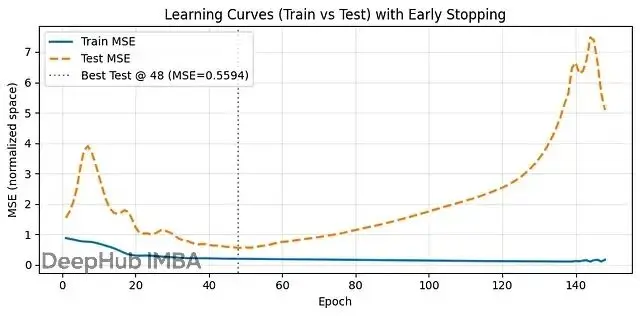
這個學習曲線展示了典型的過擬合過程。前48輪訓練和測試誤差一起下降,測試MSE達到最低值。之後訓練誤差繼續改善,但測試誤差開始上升——模型開始記憶訓練數據的噪聲,而不是學習真正的規律。這就是為什麼我們需要早停機制。
可視化結果時,還需要把標準化的數據轉換回原始單位,這樣更容易理解:
# ===== 步驟4:評估 + 可視化 =====
import numpy as np, torch, torch.nn.functional as F
import matplotlib.pyplot as plt
from pathlib import Path
from scipy.stats import pearsonr

# 1) 恢復最佳檢查點(如果尚未恢復)
ckpt = torch.load(BESTPATH, map_location=DEVICE)
model.load_state_dict(ckpt["model_state"])
model.eval()

# 2) 輔助函數:反標準化回原始毛皮計數
def denorm(X_norm: torch.Tensor) -> torch.Tensor:
    X_log = X_norm * torch.tensor(X_std.squeeze(), device=X_norm.device) + torch.tensor(X_mean.squeeze(), device=X_norm.device)
    return torch.expm1(X_log)  # log1p的逆

# 3) 在完整時間線(訓練+測試)上預測並分割
with torch.no_grad():
    Yhat = model(t)                   # (N,2) 標準化空間
Y_den    = denorm(Y)                  # (N,2) 原始單位
Yhat_den = denorm(Yhat)               # (N,2) 原始單位

# Numpy視圖
hares_obs, lynx_obs   = Y_den[:,0].cpu().numpy(),   Y_den[:,1].cpu().numpy()
hares_pred, lynx_pred = Yhat_den[:,0].cpu().numpy(), Yhat_den[:,1].cpu().numpy()

# 4) 指標(標準化空間)
def mse(a,b): return float(np.mean((a-b)**2))
def mae(a,b): return float(np.mean(np.abs(a-b)))

y_np      = Y.cpu().numpy()
yhat_np   = Yhat.detach().cpu().numpy()
y_tr, y_te      = y_np[:split],     y_np[split:]
yhat_tr, yhat_te= yhat_np[:split], yhat_np[split:]

mse_tr = mse(y_tr, yhat_tr); mae_tr = mae(y_tr, yhat_tr)
mse_te = mse(y_te, yhat_te); mae_te = mae(y_te, yhat_te)
r_te   = pearsonr(y_te.reshape(-1), yhat_te.reshape(-1))[0]

print(f"Train  MSE={mse_tr:.4f} MAE={mae_tr:.4f}")
print(f"Test   MSE={mse_te:.4f} MAE={mae_te:.4f}  | Pearson r (test)={r_te:.3f}")

# 5) 圖表
split_year = years[split-1]

# (A) 時間序列疊加:兔子
plt.figure(figsize=(10,3.6))
plt.plot(years, hares_obs, 'k-', lw=2, label="Hares (Observed)")
plt.plot(years, hares_pred, 'b--', lw=2, label="Hares (Neural ODE)")
plt.axvline(split_year, color='gray', ls='--', alpha=.7, label="Train/Test split")
plt.xlabel("Year"); plt.ylabel("Pelts (proxy for population)")
plt.title("Hares: Observed vs Neural ODE")
plt.grid(alpha=.3); plt.legend(); plt.tight_layout(); plt.show()

# (B) 時間序列疊加:猞猁
plt.figure(figsize=(10,3.6))
plt.plot(years, lynx_obs, 'k-', lw=2, label="Lynx (Observed)")
plt.plot(years, lynx_pred, 'r--', lw=2, label="Lynx (Neural ODE)")
plt.axvline(split_year, color='gray', ls='--', alpha=.7)
plt.xlabel("Year"); plt.ylabel("Pelts (proxy for population)")
plt.title("Lynx: Observed vs Neural ODE")
plt.grid(alpha=.3); plt.legend(); plt.tight_layout(); plt.show()

# (C) 預測放大(僅測試區域)
plt.figure(figsize=(8,3.6))
plt.plot(years[split:], hares_obs[split:], 'k-', lw=2, label="Hares (Obs)")
plt.plot(years[split:], hares_pred[split:], 'b--', lw=2, label="Hares (Pred)")
plt.plot(years[split:], lynx_obs[split:],  'k-', lw=1.5, alpha=.6, label="Lynx (Obs)")
plt.plot(years[split:], lynx_pred[split:], 'r--', lw=1.8, label="Lynx (Pred)")
plt.xlabel("Year"); plt.ylabel("Pelts")
plt.title("Forecast Region (Test Years)")
plt.grid(alpha=.3); plt.legend(); plt.tight_layout(); plt.show()

# (D) 相位肖像:兔子 vs 猞猁
plt.figure(figsize=(5.6,5.2))
plt.plot(hares_obs, lynx_obs, 'k.-', label="Observed")
plt.plot(hares_pred, lynx_pred, 'c.-', label="Neural ODE")
plt.xlabel("Hares (pelts)"); plt.ylabel("Lynx (pelts)")
plt.title("Phase Portrait: Predator–Prey Cycle")
plt.grid(alpha=.3); plt.legend(); plt.tight_layout(); plt.show()

# (E) 隨時間的殘差(原始單位的絕對誤差)
abs_err_hares = np.abs(hares_pred - hares_obs)
abs_err_lynx  = np.abs(lynx_pred  - lynx_obs)

plt.figure(figsize=(10,3.4))
plt.plot(years, abs_err_hares, label="|Error| Hares", lw=1.8)
plt.plot(years, abs_err_lynx,  label="|Error| Lynx",  lw=1.8)
plt.axvline(split_year, color='gray', ls='--', alpha=.7)
plt.xlabel("Year"); plt.ylabel("Absolute Error (pelts)")
plt.title("Prediction Errors over Time")
plt.grid(alpha=.3); plt.legend(); plt.tight_layout(); plt.show()

# (F) 觀察 vs 預測散點圖(原始單位)+ R^2
def r2_score(y_true, y_pred):
    y_true = np.asarray(y_true); y_pred = np.asarray(y_pred)
    ss_res = np.sum((y_true - y_pred)**2)
    ss_tot = np.sum((y_true - y_true.mean())**2) + 1e-12
    return 1.0 - ss_res/ss_tot

r2_hares = r2_score(hares_obs[split:], hares_pred[split:])
r2_lynx  = r2_score(lynx_obs[split:],  lynx_pred[split:])

plt.figure(figsize=(9,3.6))
plt.subplot(1,2,1)
plt.scatter(hares_obs[split:], hares_pred[split:], s=35, alpha=.85)
plt.plot([hares_obs.min(), hares_obs.max()],
         [hares_obs.min(), hares_obs.max()], 'k--', lw=1)
plt.title(f"Hares (Test): R²={r2_hares:.2f}")
plt.xlabel("Observed"); plt.ylabel("Predicted"); plt.grid(alpha=.3)

plt.subplot(1,2,2)
plt.scatter(lynx_obs[split:], lynx_pred[split:], s=35, alpha=.85, color='tab:red')
plt.plot([lynx_obs.min(), lynx_obs.max()],
         [lynx_obs.min(), lynx_obs.max()], 'k--', lw=1)
plt.title(f"Lynx (Test): R²={r2_lynx:.2f}")
plt.xlabel("Observed"); plt.ylabel("Predicted"); plt.grid(alpha=.3)

plt.tight_layout(); plt.show()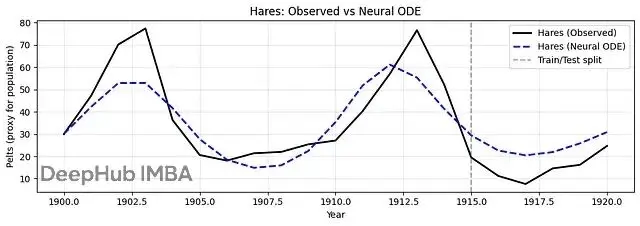
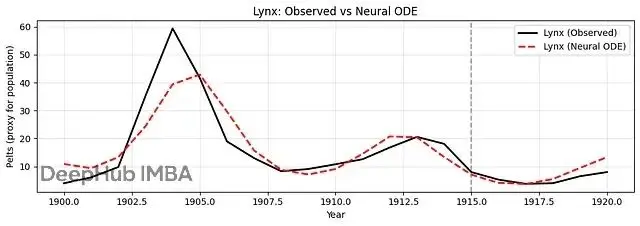
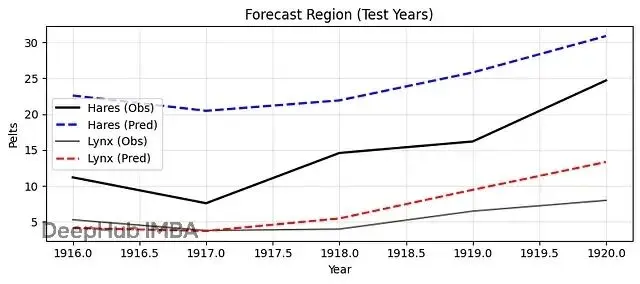
結果顯示Neural ODE成功捕捉了捕食者-獵物系統的週期性動力學。模型學會了兔子和猞猁種羣的相互依賴關係,能夠產生平滑的預測軌跡。
如果擬合效果不夠好,可以嘗試:延長訓練時間(
EPOCHS=5000),增加網絡容量(
hidden=96),或者調低學習率(
lr=2e-3)。
總結
通過一個實際案例我們看到了Neural ODE技術的強大潛力。它不僅是數學上的優雅理論,更是解決實際問題的有力工具。
Neural ODE的核心價值在於連續性思維:世界本質上是連續的,而傳統深度學習的離散化可能丟失重要信息。通過引入微分方程,我們能夠更自然地建模連續過程,處理不規律的時間序列數據,獲得更好的數值穩定性,並實現更精確的時間建模。
當然Neural ODE也並非萬能。它的計算成本較高,對初值敏感,調參也相對複雜。但隨着硬件算力提升和算法優化,這些問題正在逐步解決。
正如物理學家費曼所説:"我們需要的不僅是計算能力,更是對自然規律的深刻理解。"Neural ODE正是這種理解與計算的完美結合。
https://avoid.overfit.cn/post/af8511a953524409b9f41fd27d5958b7
作者:Rayan Yassminh
